
Nifty 50 at a 'Launchpad' Moment: History Predicts 30% Gains After 17-Month Stagnation
Published: 2026-03-17 18:40 IST | Category: Markets | By Flash Finance desk (written with AI assistance) · Editor: Kokila
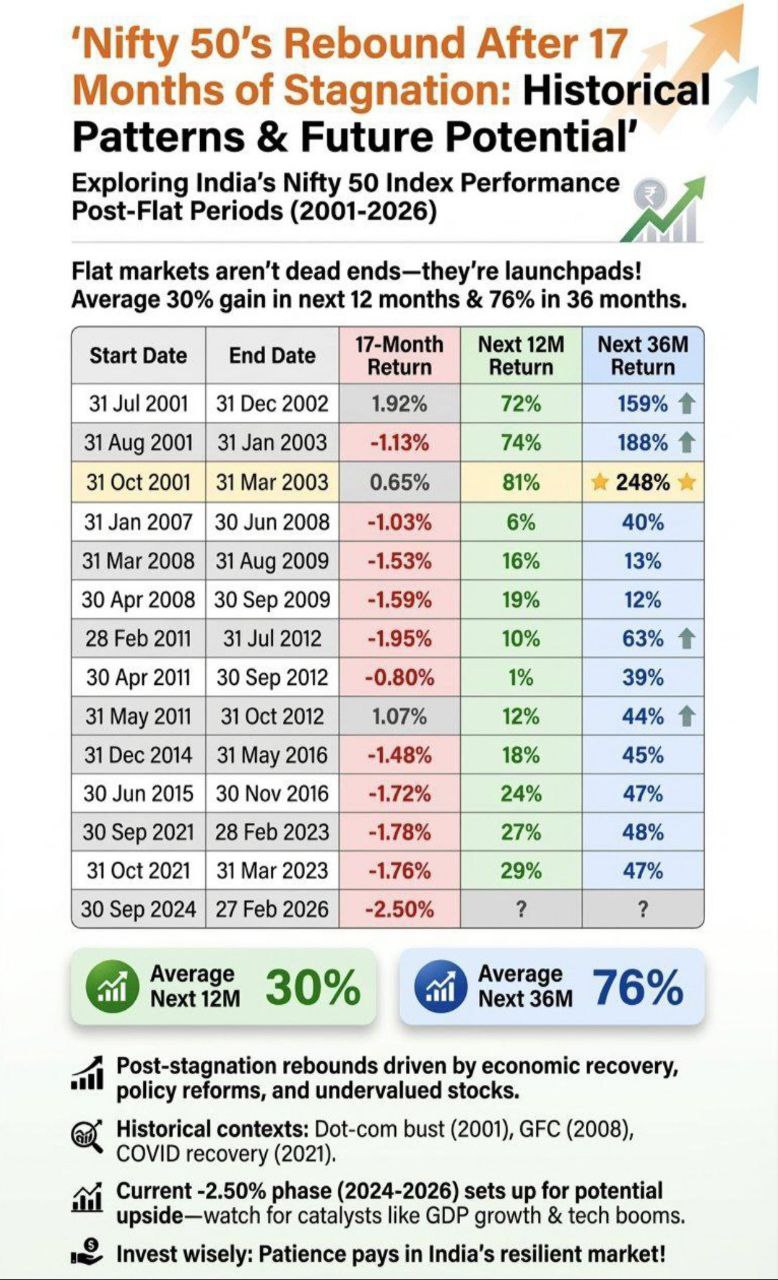
The Indian stock market is currently standing at a critical psychological and technical juncture. After 17 months of virtually zero progress—a phase market experts are calling a "time correction"—the benchmark Nifty 50 index appears to be coiled like a spring. According to recent data shared by Edelweiss Mutual Fund and analyzed against 25 years of market history, the period from September 30, 2024, to February 27, 2026, mirrors past cycles that preceded some of India's most explosive bull runs.
The 17-Month Stagnation Phase The latest data point in the Nifty's journey shows a -2.50% return over the 17-month window ending in February 2026. This period has been characterized by extreme volatility, driven by geopolitical tensions in West Asia and surging global oil prices, which recently crossed the $110 per barrel mark. Despite these external headwinds, the "flat" performance is not a sign of weakness but rather a period of consolidation where "fear is overruling greed," according to market analysts.
Historical Patterns of Recovery Looking back at the last 25 years, every instance of a 17-month "dead" period has been followed by a significant trend reversal. Historical contexts such as the Dot-com bust recovery (2001), the post-GFC rebound (2008), and the COVID-19 recovery (2021) show a recurring pattern of high-double-digit gains.
Average Returns Post-Stagnation:
- Next 12 Months: Average gain of 30%.
- Next 36 Months: Average gain of 76%.
- Historical Peak: Following the 2001 stagnation, the Nifty surged by a staggering 248% over the subsequent three years.
Current Catalysts for the FY27 Rebound While the global environment remains turbulent, India’s domestic macroeconomic indicators remain robust. Fitch Ratings recently revised India’s GDP growth projection for FY26 upwards to 7.5%, citing resilient consumption and strong government infrastructure spending.
Key Drivers to Watch:
- Corporate Earnings: Analysts expect a double-digit earnings recovery in FY27 as input cost pressures from oil begin to stabilize.
- Policy Reforms: Anticipated GST rationalization and the implementation of the 8th Pay Commission are expected to boost household disposable income.
- Tech and AI Boom: Increased AI integration across Indian IT services and finance is creating new revenue streams, reinforcing long-term fundamentals.
- Valuation Comfort: With the Nifty P/E ratio hovering near 20.3, valuations have normalized from the "frothy" levels seen in early 2024, offering a better entry point for long-term investors.
Investment Strategy for the Indian Audience The message for retail investors in Mumbai to Mizoram is clear: patience is the ultimate currency. While the recent "market wealth wipeout" of Rs 36 lakh crore due to West Asia tensions has caused panic, historical data suggests that these are the moments when the foundation for the next rally is built.
Financial advisors recommend a disciplined approach to navigate the current volatility. Systematic Investment Plans (SIPs) and Systematic Transfer Plans (STPs) remain the most effective tools for rupee-cost averaging, especially as the market prepares for its potential 30% breakout in the coming fiscal year. As the historical data proves, flat markets aren't dead ends—they are the launchpads for India's resilient growth story.