
Decoding NSE's Ownership: A Glimpse into India's Financial Backbone as of March 2025
Published: 2025-07-04 00:44 IST | Category: Markets | By Flash Finance desk (written with AI assistance) · Editor: Kokila
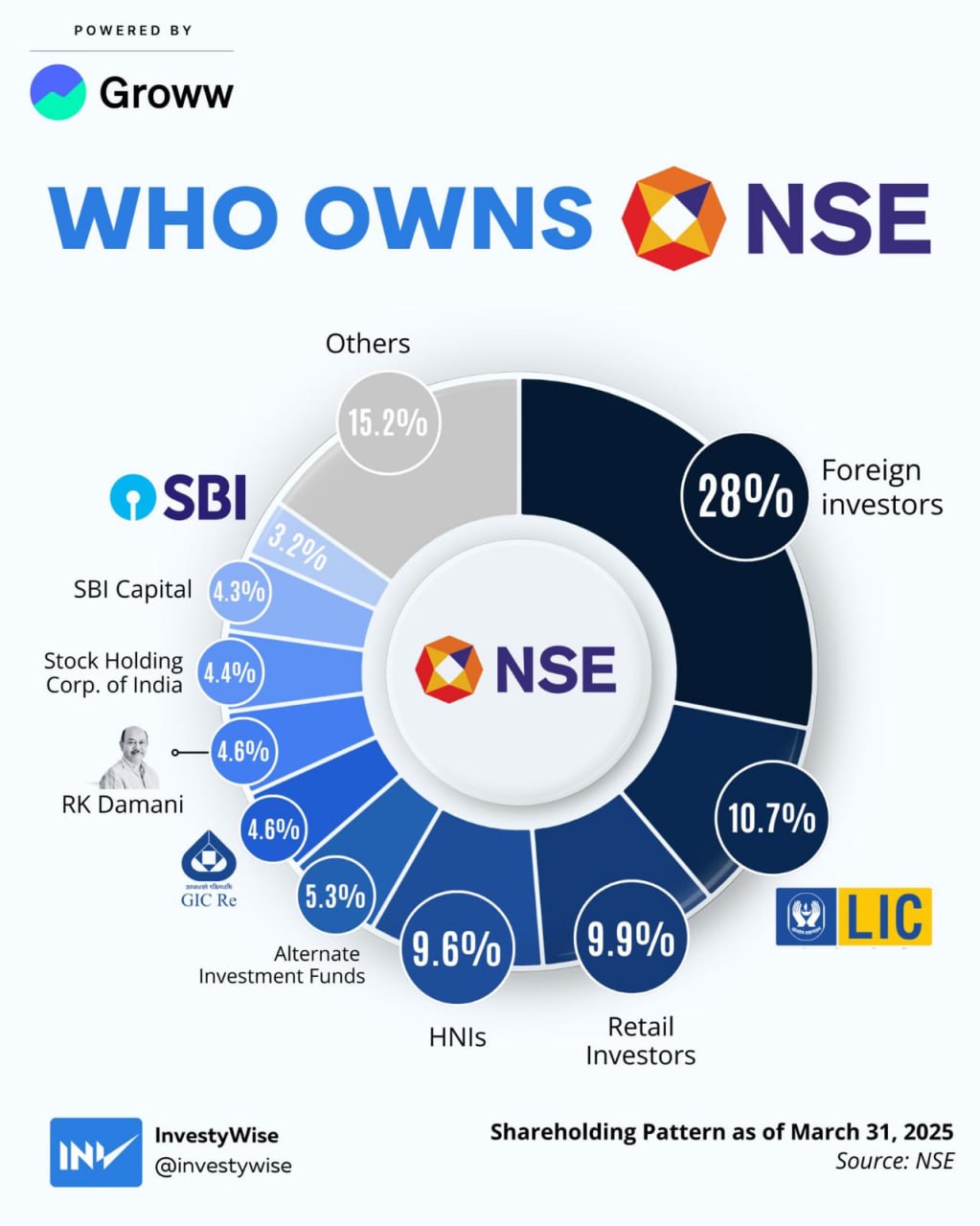
The National Stock Exchange of India (NSE), a cornerstone of India's financial infrastructure, presents a multifaceted ownership structure as of March 31, 2025. This pattern reveals a blend of institutional powerhouses, individual investors, and international entities, underscoring the exchange's critical role in the Indian economy.
Key Shareholders and Their Stakes
According to the shareholding pattern, foreign investors collectively hold a substantial 28% stake in the NSE. This significant foreign interest highlights global confidence in India's capital markets and the NSE's operational prowess.
Among domestic entities, the Life Insurance Corporation of India (LIC) stands out as a major investor, holding a 10.7% stake. LIC's investment in the unlisted NSE has become one of its most valuable holdings, reflecting its strategic diversification within India's top companies.
Other prominent Indian institutional investors include: * State Bank of India (SBI) with 3.2%. * SBI Capital with 4.3%. * Stock Holding Corporation of India, holding 4.4%. * GIC Re, holding 4.6%.
Ace investor Radhakishan Damani also holds a notable 4.6% stake in the exchange. His investment in NSE is poised to unlock substantial value, especially with the impending IPO.
The pattern further details: * Alternate Investment Funds: 5.3% * High-Net-Worth Individuals (HNIs): 9.6% * Retail Investors: 9.9% * Others: 15.2%
This distribution signifies a broad participation from various investor categories, emphasizing the democratization of wealth creation through India's capital markets.
The Growing Influence of Domestic Investors
The substantial holdings by Indian public sector undertakings (PSUs) like LIC, SBI, SBI Capital, and Stock Holding Corporation of India underline the government's significant indirect ownership and strategic interest in the exchange's success. Collectively, Indian PSUs hold approximately 31% stake in NSE, valued at around ₹1.74 lakh crore.
The combined share of domestic institutional investors (DIIs), retail investors, and HNIs in the broader Indian market has reached an all-time high, creating a strong counterbalance to foreign inflows. While the specific figures for NSE's direct ownership differ from the broader market trends of NSE-listed companies, the image's data for NSE itself shows a healthy mix of domestic and foreign capital.
Anticipation Builds for NSE IPO
The shareholding pattern gains even more significance given the long-anticipated Initial Public Offering (IPO) of the NSE. Market observers and existing shareholders, particularly LIC and Radhakishan Damani, are keenly awaiting the public listing, which is expected to unlock massive value. Recent reports indicate that the NSE is clearing regulatory hurdles, with the Securities and Exchange Board of India (SEBI) signaling a positive stance towards the IPO, potentially paving the way for a listing by late 2025 or FY26.
The NSE's estimated valuation has climbed to approximately ₹5.7 lakh crore, positioning it among India's most valuable companies even before its public debut. This strong valuation, coupled with the diverse and strategic ownership, reflects the exchange's robust position and its pivotal role in shaping the future of India's financial landscape.