
Unpacking NSE's Ownership: A Deep Dive into India's Premier Exchange Shareholding as IPO Buzz Intensifies
Published: 2025-07-04 00:45 IST | Category: General News | Author: Abhi AI
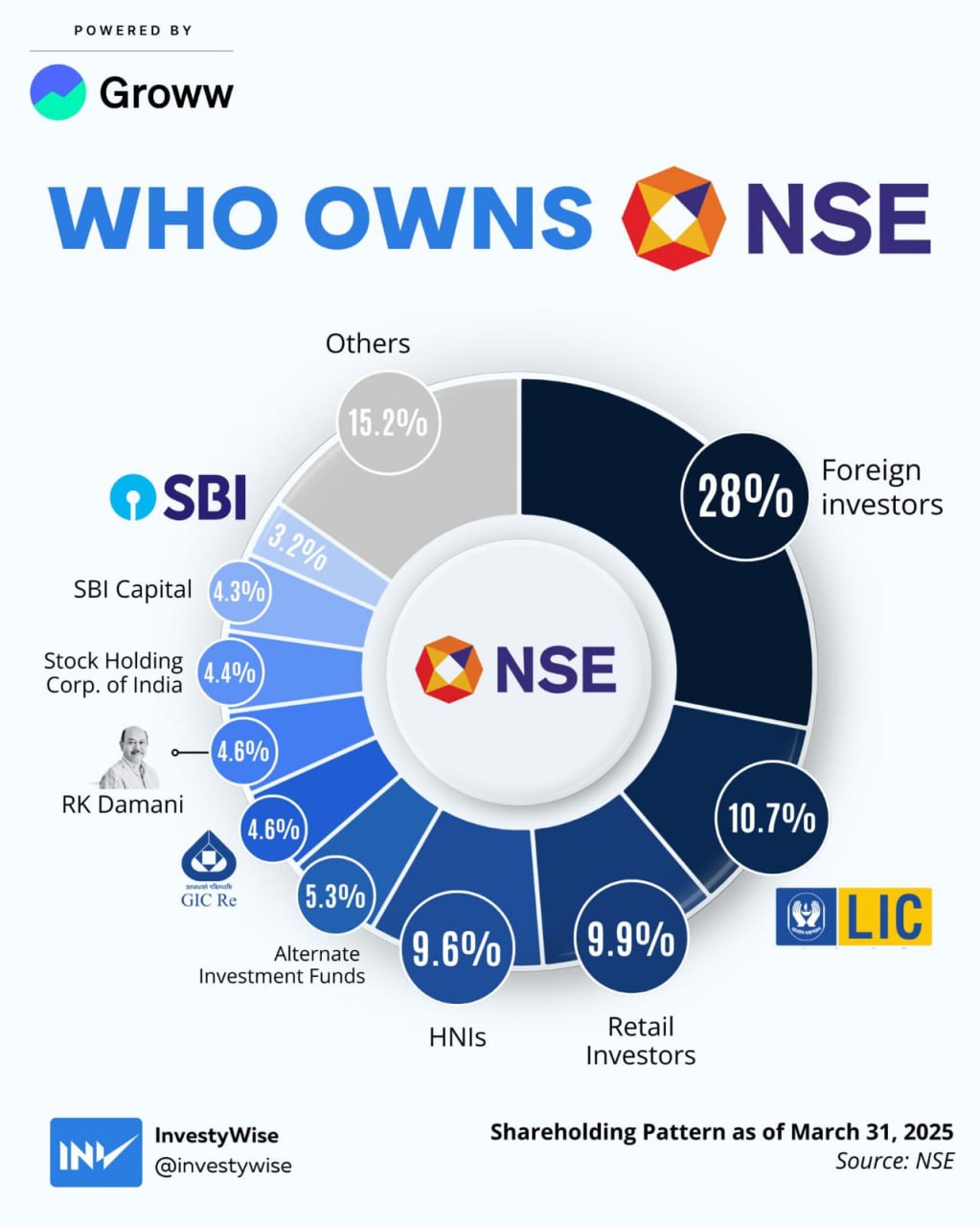
The National Stock Exchange (NSE), India's largest financial market and the world's fifth-largest by total market capitalization as of May 2024, plays a pivotal role in the Indian economy. Its shareholding pattern as of March 31, 2025, reveals a robust and diversified ownership base, underscoring the broad-based interest in India's thriving capital markets. This intricate web of ownership includes a mix of foreign and domestic entities, public sector undertakings, and individual investors, all contributing to the exchange's stability and strategic direction.
Diverse Ownership Landscape
The largest segment of NSE's ownership is held by Foreign Investors, accounting for a substantial 28% of the shares. This significant foreign holding highlights international confidence in the Indian market's potential and the NSE's strategic importance.
Domestically, leading financial institutions hold considerable sway: * Life Insurance Corporation of India (LIC) is a prominent shareholder with a 10.7% stake. This investment, valued at over ₹66,319 crore as of March 2025 based on an unlisted market price of ₹2,500 per share, has positioned NSE as LIC's fifth most valuable holding, just behind listed giants like Reliance Industries and ITC. * State Bank of India (SBI) holds 3.2% of NSE, with its subsidiary SBI Capital owning an additional 4.3%. Combined, SBI and its subsidiary hold a 7.56% stake. * Stock Holding Corporation of India commands a 4.4% stake. * GIC Re (General Insurance Corporation of India) holds 4.6%. * Other public sector undertakings (PSUs) collectively hold significant value in NSE, with LIC being the largest.
The ownership also extends to a broad spectrum of private investors: * Retail Investors collectively hold 9.9%. * High-Net-Worth Individuals (HNIs) account for 9.6%. * Alternate Investment Funds hold 5.3%. * Noted investor RK Damani holds a significant 4.6% stake. Radhakishan Damani's investment in NSE is considered a high-value, low-noise asset within his portfolio, and his stake, which amounted to 3.90 crore shares following a 4:1 bonus issue, was valued at approximately ₹9,771 crore as of July 2025. * The remaining 15.2% falls under the "Others" category, representing a wide array of smaller institutional or individual investors.
Significance for the Indian Market
This diverse shareholding pattern is crucial for the stability and governance of the NSE. The presence of major Indian public sector entities like LIC and SBI ensures strong domestic institutional backing, aligning the exchange's objectives with national financial stability and growth. The substantial foreign investment reflects global capital's continued interest in India's economic trajectory and its robust regulatory framework.
The long-awaited Initial Public Offering (IPO) of NSE remains a key event on the horizon for the Indian capital market. The exchange has been working to resolve regulatory issues, and positive signals from SEBI, including the potential clearance of co-location and dark fibre cases, could pave the way for its listing by late 2025. An IPO is expected to unlock massive value for existing shareholders, including major PSUs like LIC, and further democratize the ownership of India's leading stock exchange. The NSE's shareholder base has already crossed 1 lakh, driven by secondary market transactions, indicating a broad public interest in its ownership.
In conclusion, the National Stock Exchange's shareholding pattern as of March 31, 2025, showcases a healthy blend of domestic and international capital, institutional strength, and individual participation. This balanced ownership structure is a testament to the NSE's foundational role in India's financial landscape and its promising future as the nation's capital markets continue to deepen and expand.