
Unpacking NSE's Ownership: A Deep Dive into India's Premier Exchange as IPO Nears
Published: 2025-07-04 00:46 IST | Category: Markets | By Flash Finance desk (written with AI assistance) · Editor: Kokila
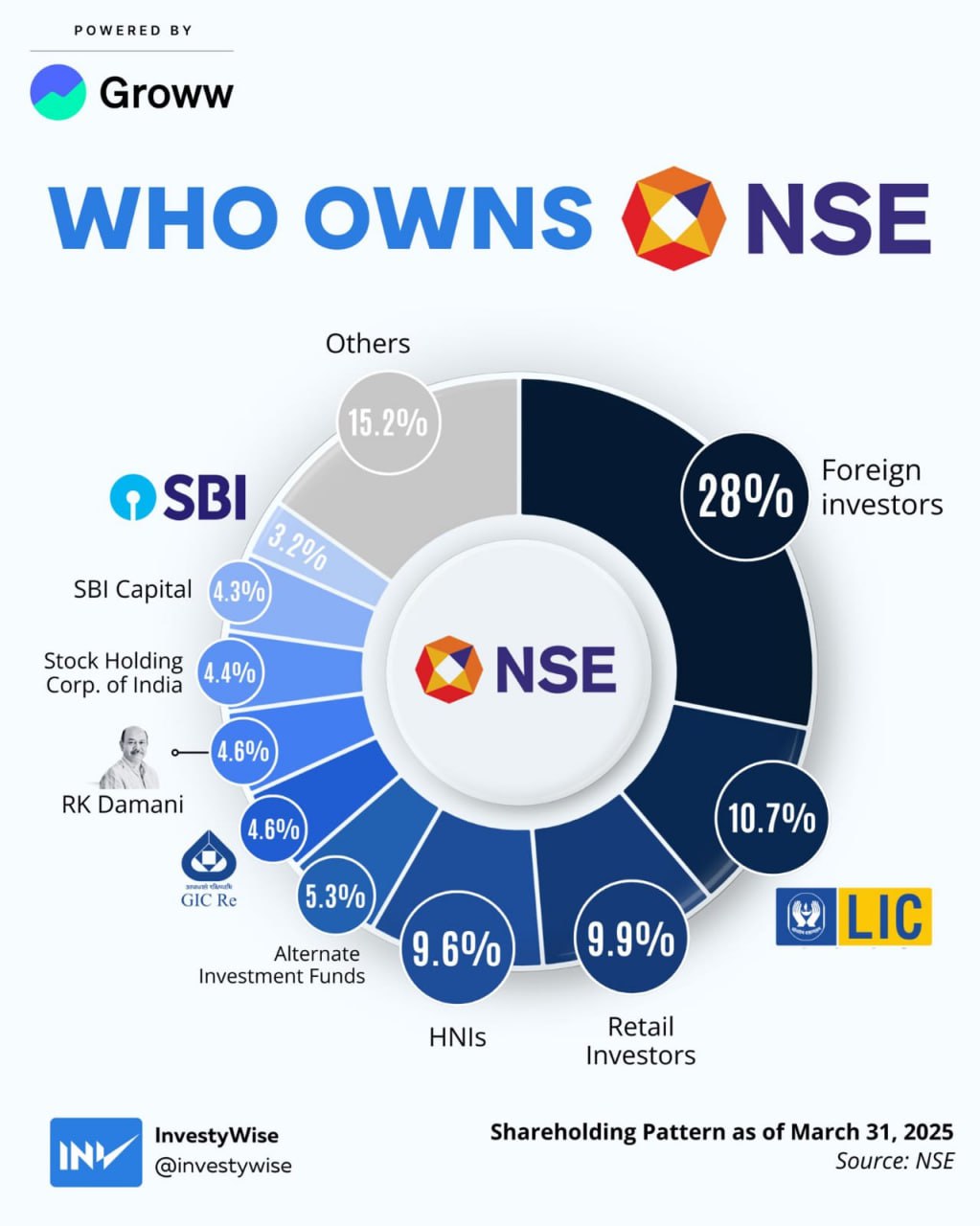
The National Stock Exchange (NSE), India's leading stock exchange and the world's largest derivatives exchange by number of contracts traded, showcases a multifaceted ownership structure as of March 31, 2025. This composition highlights a strategic balance between institutional, retail, and foreign investors, reflecting the broad-based interest in India's robust financial infrastructure.
Key Shareholders and Their Stakes Analysis of the shareholding pattern reveals a significant footprint of Indian public sector entities and domestic financial institutions. * Foreign Investors collectively hold the largest single block at 28%. This substantial foreign ownership underscores global confidence in the Indian market's growth potential. * Life Insurance Corporation (LIC), India's largest institutional investor, holds a notable 10.7% stake in the NSE. This investment has recently emerged as one of LIC's top six most valuable holdings, despite NSE being an unlisted entity, with its value estimated at over ₹63,374 crore based on March 2025 data. * Retail Investors account for 9.9% of the ownership, signifying the increasing direct participation of the Indian populace in the financial markets. * High-Net-Worth Individuals (HNIs) command a 9.6% share, indicating a strong interest from affluent domestic investors. * Alternate Investment Funds hold 5.3%. * GIC Re (General Insurance Corporation of India) maintains a 4.6% stake. * Prominent individual investor RK Damani holds 4.6%. * Stock Holding Corporation of India (SHCIL), a major Indian custodian, holds 4.4%. This stake is particularly relevant as IFCI, holding over 50% in SHCIL, could indirectly benefit significantly from a potential NSE IPO. * SBI Capital (SBI Capital Markets) accounts for 4.3% of the ownership. * State Bank of India (SBI), one of India's largest public sector banks, holds 3.2%. * The remaining 15.2% is categorized under "Others", which includes various other financial institutions and private equity investors.
Implications for the Indian Market The diverse ownership structure, particularly the substantial stakes held by Indian public sector entities like LIC and SBI, highlights the foundational role these institutions play in the country's financial ecosystem. The increasing share of retail and HNI investors also points to a growing financial awareness and direct engagement of Indian citizens with capital markets, a trend that has been observed across the broader Indian equity market.
The Anticipated NSE IPO The potential Initial Public Offering (IPO) of NSE remains one of the most keenly awaited events in the Indian financial landscape. While the exchange has faced regulatory hurdles and legal issues in the past, including matters related to co-location and dark fiber, recent developments suggest progress towards resolution. NSE reportedly filed a significant consent settlement application with SEBI in June 2025 to address these long-pending issues. A successful settlement is expected to pave the way for SEBI to issue a No Objection Certificate (NoC), a mandatory requirement for Market Infrastructure Institutions (MIIs) to go public, potentially enabling the IPO to materialize around Diwali. The listing of NSE, a key financial institution, would mark a historic moment for India's capital markets and could unlock significant value for its current shareholders, including major public sector undertakings.
