
NSE's Diverse Ownership: A Look at India's Financial Backbone Ahead of Anticipated IPO
Published: 2025-07-04 00:50 IST | Category: Markets | By Flash Finance desk (written with AI assistance) · Editor: Kokila
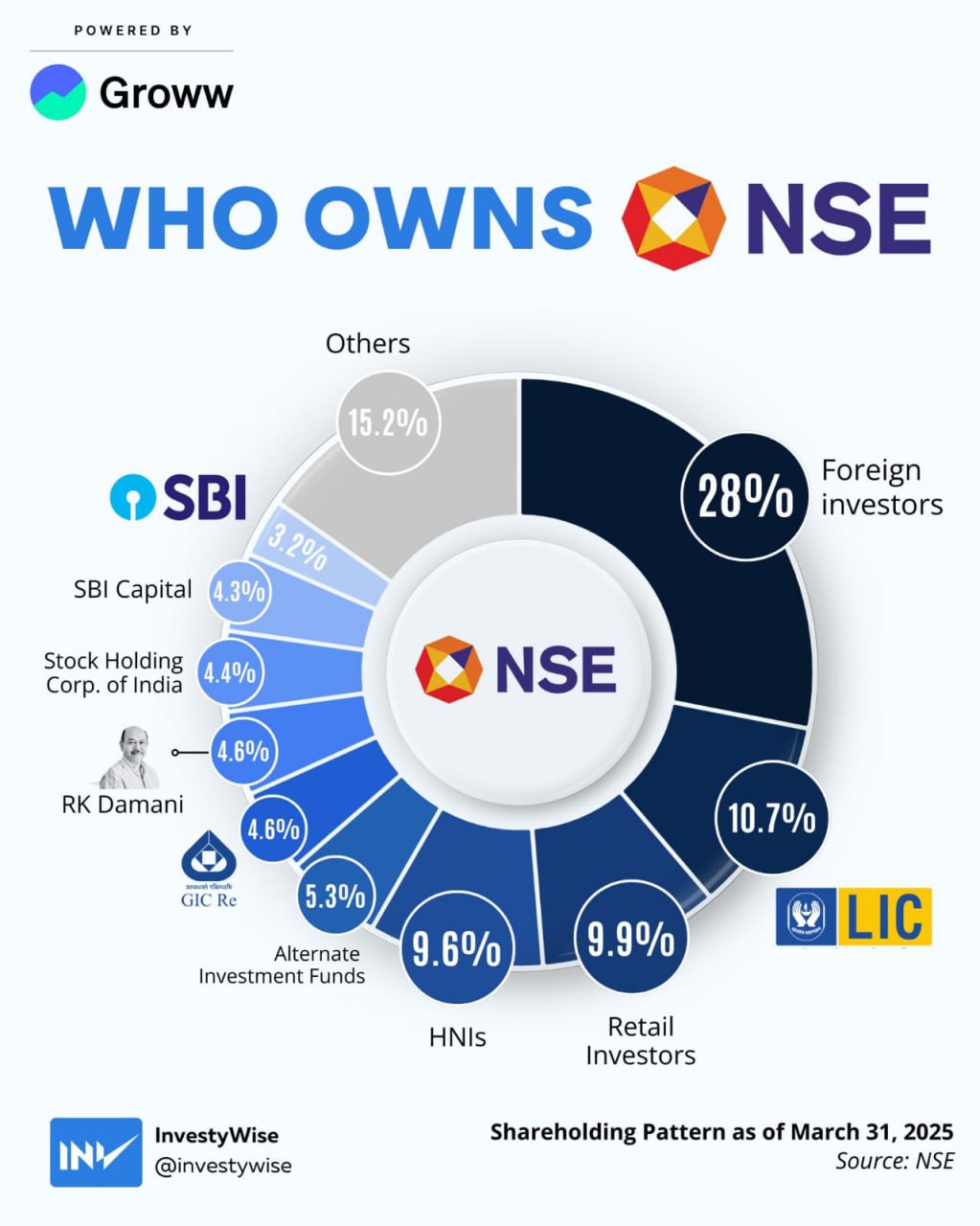
The National Stock Exchange of India (NSE), a pivotal institution in the country's financial landscape, showcases a robust and diverse ownership structure as of March 31, 2025. This intricate web of shareholding underscores the broad-based participation in India's capital markets, ranging from large public sector entities to individual retail investors. The latest shareholding pattern reveals key players poised to benefit significantly from the exchange's impending public listing.
Key Shareholders and Their Stakes
According to the shareholding pattern, the ownership of NSE is distributed as follows:
- Foreign Investors: Holding the largest single block, foreign investors collectively own 28% of the NSE. [Image] This significant foreign participation highlights global confidence in India's financial infrastructure. Search results confirm that Foreign Direct Investments and Foreign Portfolio Investors (FPIs) together account for this substantial stake.
- Life Insurance Corporation (LIC): India's largest institutional investor, LIC, holds a substantial 10.7% stake in the NSE. [Image] This investment is notably one of LIC's most valuable holdings, despite NSE currently being an unlisted entity, with its value estimated at approximately ₹63,374 crore as of March 2025.
- Retail Investors: Demonstrating the growing retail participation in India's equity story, individual retail investors account for 9.9% of NSE's ownership. [Image] This aligns with the trend of increasing direct ownership by individual investors, which climbed to 9.5% in NSE-listed companies by March 2025.
- High Net-worth Individuals (HNIs): HNIs collectively hold 9.6% of the exchange. [Image]
- Alternate Investment Funds: These funds collectively own 5.3% of the NSE. [Image]
- GIC Re: General Insurance Corporation of India (GIC Re) holds a 4.6% stake. [Image]
- R K Damani: The renowned Indian investor, Radhakishan Damani, holds 4.6% of the NSE. [Image] While the image shows 4.6% as of March 2025, more recent reports indicate that after a bonus issue, Damani's stake stands at approximately 1.58%, amounting to 3.91 crore shares, valued at around ₹9,300 crore. This makes NSE his second most valuable investment after Avenue Supermarts (DMart).
- Stock Holding Corporation of India: This entity holds 4.4% of the NSE. [Image]
- SBI Capital: SBI Capital Markets, a subsidiary of State Bank of India, holds 4.3%. [Image]
- SBI: State Bank of India directly owns 3.2% of the NSE. [Image] Combined with SBI Capital Markets, SBI's total stake is significant.
- Others: The remaining 15.2% is held by various other entities. [Image]
Notably, public sector undertakings (PSUs) like LIC, SBI, and Stock Holding Corporation of India collectively command a significant ownership, amounting to approximately 23% of the NSE, valued at over ₹1.3 lakh crore.
The Long-Awaited IPO and Regulatory Clarity
The National Stock Exchange's Initial Public Offering (IPO) has been one of the most anticipated events in the Indian financial markets, facing prolonged delays due to regulatory concerns, particularly related to co-location and dark fibre issues. However, there is now significant optimism that the IPO is firmly on track.
Recent developments indicate that the Securities and Exchange Board of India (SEBI) is likely to grant a 'No Objection Certificate' (NOC) by July 2025, paving the way for the listing. NSE has been actively addressing regulatory concerns, including submitting a settlement application of ₹1,388 crore to SEBI to resolve long-pending cases. SEBI officials have stated that there are no longer any fundamental obstacles to the IPO.
The unlisted share price of NSE has seen a surge, rising over 50% in the past month, driven by this renewed IPO optimism. If the IPO proceeds as expected, it could launch in Q4 FY26 (January-March 2026). The exchange is estimated to have a total valuation ranging between ₹5.7 lakh crore and ₹5.98 lakh crore, which would position it among India's most valuable companies upon listing.
Impact on the Indian Market
NSE's listing is expected to be a landmark event for the Indian financial market. As the world's 5th largest stock exchange by market capitalization and the largest derivatives exchange, its public debut will not only unlock significant value for its existing shareholders but also enhance transparency and corporate governance. The listing is anticipated to attract substantial investor interest, further deepening India's capital markets and reinforcing its position as a global financial hub.
