
Unpacking NSE's Ownership: A Glimpse into India's Financial Backbone as of March 2025
Published: 2025-07-04 00:52 IST | Category: Markets | By Flash Finance desk (written with AI assistance) · Editor: Kokila
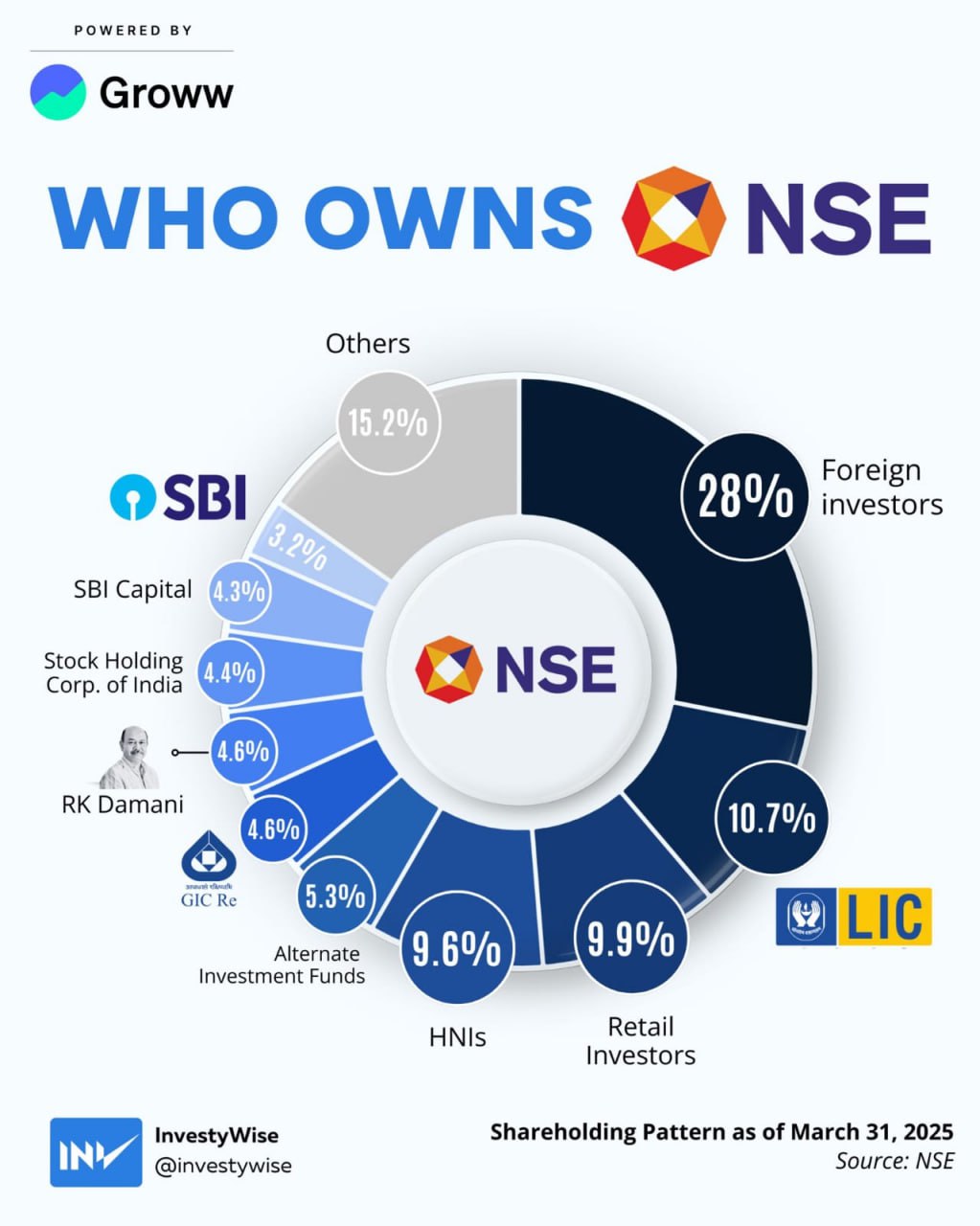
The National Stock Exchange (NSE) of India, recognized as the country's leading stock exchange and one of the world's largest by market capitalization, plays a pivotal role in facilitating India's economic growth. Its diverse ownership structure, as of March 31, 2025, reveals a blend of global and domestic stakeholders, highlighting the widespread trust and strategic investments in India's robust financial ecosystem.
Key Shareholding Insights
The shareholding pattern indicates a broad distribution among various investor categories:
-
Foreign Investors: Holding the largest single share, foreign investors collectively own 28% of the NSE. Foreign investment in Indian stock markets has been permitted since 1992, with the introduction of the Foreign Portfolio Investor (FPI) framework in 2014 to streamline foreign participation. The limit for foreign shareholding in Indian stock exchanges was increased from 5% to 15% in 2016. While the 28% figure suggests substantial foreign interest in NSE's equity, the ownership is spread across various global financial institutions and private equity firms.
-
Life Insurance Corporation (LIC): India's largest institutional investor, LIC, holds a significant 10.7% stake in the NSE. This investment has emerged as one of LIC's top six most valuable holdings, despite NSE's unlisted status, with its value estimated at approximately ₹63,374 crore based on the unlisted market price as of March 2025. LIC's substantial stake underscores its strategic confidence in India's financial infrastructure.
-
Retail and High Net Worth Individuals (HNIs): Indicating a growing democratization of wealth in India's equity markets, Retail Investors hold 9.9% and High Net Worth Individuals (HNIs) account for 9.6% of NSE's ownership. This significant participation from individual investors reflects a broader trend of increased direct equity participation by Indian households.
-
Other Key Indian Institutions: Several other prominent Indian public sector entities and financial institutions are significant shareholders:
- Alternate Investment Funds (AIFs) hold 5.3%.
- GIC Re (General Insurance Corporation of India) owns 4.6%.
- Stock Holding Corporation of India holds 4.4%.
- SBI Capital, a subsidiary of State Bank of India, has a 4.3% stake.
- State Bank of India (SBI) itself holds 3.2%.
-
Ace Investor R.K. Damani: Renowned Indian investor Radhakishan Damani holds a 4.6% stake in the NSE. His investment in the exchange has gained considerable attention, especially with the ongoing discussions surrounding NSE's potential public listing. Reports suggest that Damani's stake, including a recent bonus issue, is valued at approximately ₹9,300 crore, positioning NSE as his second most valuable investment after Avenue Supermarts.
-
Others: The remaining 15.2% of the NSE is held by a diverse group of other investors.
The Road Ahead: NSE's Anticipated IPO
The diverse and robust ownership structure of the NSE comes into sharper focus as the exchange moves closer to its long-awaited Initial Public Offering (IPO). The IPO is expected to unlock substantial value for its existing shareholders, including the various institutional and individual investors. Recent developments, including the resolution of certain regulatory hurdles and legal cases, are clearing the path for the public listing, potentially by FY26. The NSE's shareholder base has already surpassed 1 lakh individuals, further fueling the anticipation for its market debut.
The current shareholding pattern underscores the stability and strategic importance of the National Stock Exchange as a critical component of India's financial infrastructure, with a strong foundation built on a wide array of domestic and international investors.
