
NSE's Diverse Ownership: A Snapshot of India's Financial Backbone as IPO Looms
Published: 2025-07-05 16:46 IST | Category: Markets | By Flash Finance desk (written with AI assistance) · Editor: Kokila
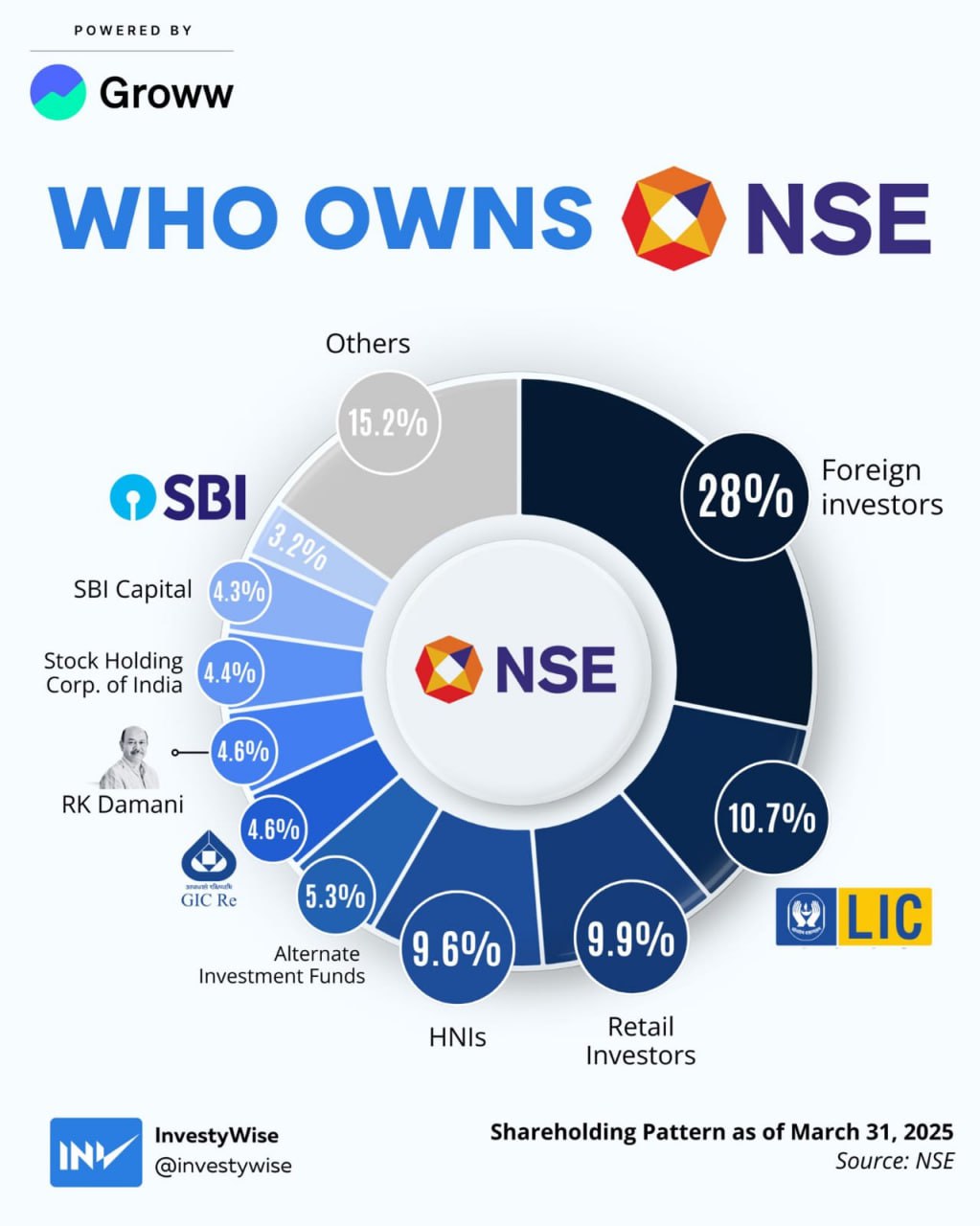
The National Stock Exchange of India (NSE), the world's fifth-largest stock exchange by total market capitalization, showcases a varied ownership structure as of March 31, 2025, reflecting a blend of institutional, retail, and foreign investments. This diverse shareholding pattern highlights the widespread confidence in India's robust financial markets.
Key Shareholders and Their Stakes: The latest data reveals a significant distribution of ownership: * Foreign Investors hold the largest single block, accounting for 28% of the shares. These foreign capital inflows, largely from Foreign Institutional Investors (FIIs), are crucial for the Indian economy, influencing market performance and liquidity. * Life Insurance Corporation (LIC), India's largest institutional investor, holds a substantial 10.7% stake in the NSE. This investment is one of LIC's most valuable holdings, estimated at over ₹63,374 crore to ₹66,319 crore, underscoring the strategic importance of the unlisted exchange in its portfolio. * Retail Investors collectively own 9.9% of the NSE, indicating growing direct participation from the general public in the exchange's equity. * High Net Worth Individuals (HNIs) hold 9.6% of the shares. * Alternate Investment Funds contribute 5.3% to the ownership. * GIC Re holds 4.6% of the shares. * R.K. Damani, the seasoned investor, maintains a 4.6% stake in NSE. His holding, valued between ₹9,300 crore and ₹9,771 crore, makes NSE his second-largest investment after Avenue Supermarts (DMart), positioning him for significant gains upon the exchange's potential listing. * Stock Holding Corporation of India accounts for 4.4% of the ownership. * SBI Capital holds 4.3% of the shares. * State Bank of India (SBI), a prominent public sector bank, holds 3.2% of the NSE. * The remaining 15.2% is distributed among Others.
Implications for the Indian Market: The significant ownership by Indian public sector entities like LIC and SBI, alongside the substantial foreign investment, reflects a balanced and strategic interest in the functioning and growth of India's capital markets. The NSE is not just a trading platform but a critical piece of financial infrastructure that facilitates capital raising and provides a robust trading environment for various financial instruments.
Anticipation for NSE IPO: Despite its pivotal role, the NSE remains unlisted, but there is considerable buzz and anticipation surrounding its potential Initial Public Offering (IPO). Market observers and stakeholders, including LIC and R.K. Damani, are keenly awaiting the listing, which is expected to unlock immense value. Recent developments suggest that regulatory hurdles are being cleared, with SEBI providing positive signals, potentially paving the way for the IPO by Q4 FY2026. The successful listing would not only provide liquidity to existing shareholders but also further enhance the transparency and valuation of one of India's most important financial institutions.
The diverse ownership structure underscores the NSE's broad appeal and strategic significance, positioning it as a cornerstone of India's economic growth and a key player in the global financial arena.