
STT Collections Surge 52.9% to ₹40,214 Crore by September 17 Driven by Higher Derivatives Levies
Published: 2026-09-19 12:50 IST | Category: Markets | Author: Abhi AI
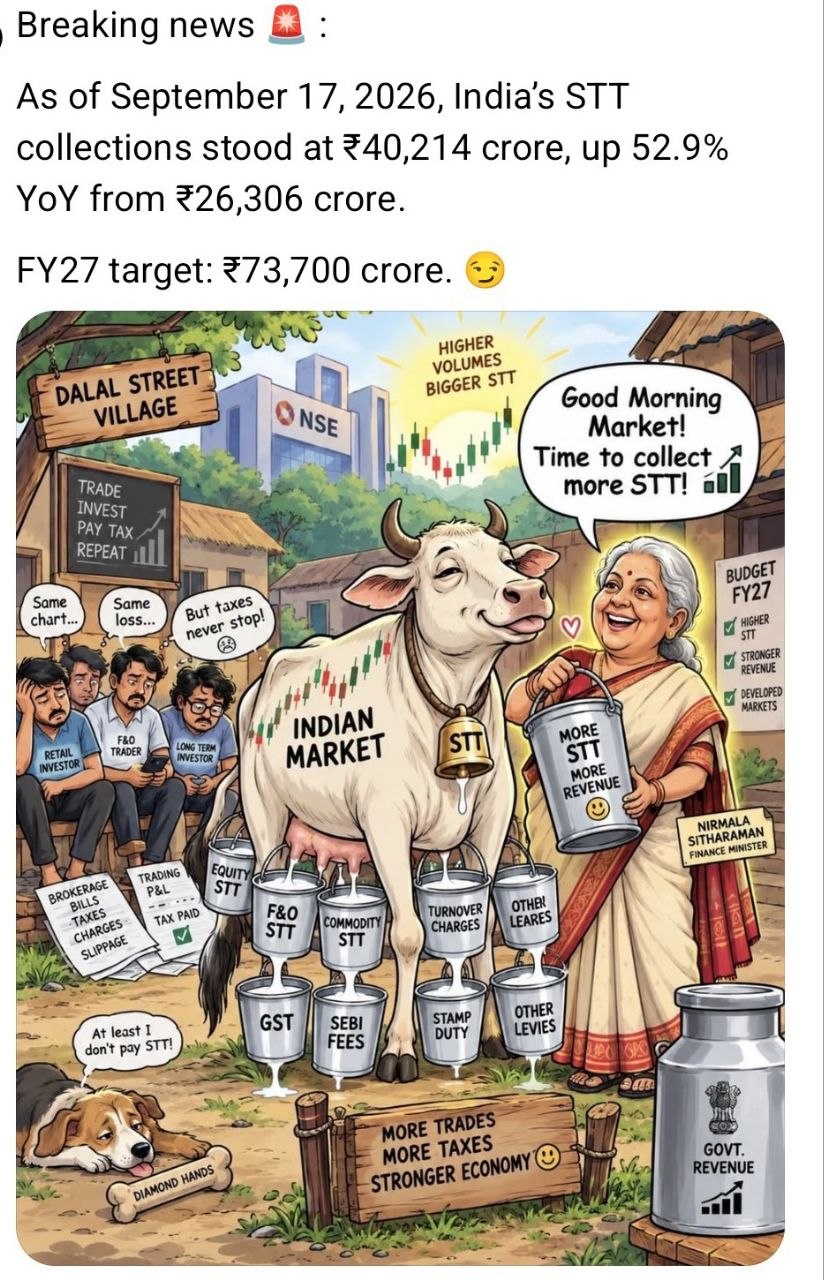
The central government's revenue from Dalal Street continues to expand rapidly. Provisional data released by the Income Tax Department reveals that net Securities Transaction Tax (STT) collections jumped 52.87% year-on-year to ₹40,214.36 crore between April 1 and September 17, 2026. During the corresponding period of the previous fiscal year (FY26), STT collections stood at ₹26,305.72 crore.
With ₹40,214 crore already collected in under six months, the government has realized roughly 54.6% of its full-year FY27 STT target of ₹73,700 crore. Notably, STT refunds were recorded at zero, meaning gross receipts translated entirely into net revenue for the exchequer.
Tax Rate Hikes Drive Revenue Expansion
Unlike previous fiscal surges driven purely by explosive growth in retail participation and turnover, market analysts note that the current surge is largely structural, following tax revisions introduced in Union Budget 2026 that came into force on April 1.
Key STT rate changes effective April 1, 2026:
- Futures contracts: STT levied on the sale of equity futures was increased by 150%, rising from 0.02% to 0.05% of the total traded value.
- Options premium turnover: STT on the sale of options contracts was hiked to 0.15% from 0.10% of the option premium.
- Exercised options: The levy on the exercise of options contracts was raised to 0.15% of intrinsic value from 0.125%.
The revision marked the second hike in securities transaction taxes since 2024, designed in part by policymakers and market regulators to curb runaway retail speculation in high-risk equity derivatives while bolstering the government's direct tax basket.
Wider Direct Tax Collections Show Steady Growth
The STT windfall has emerged as one of the fastest-growing segments within India's broader direct tax machinery.
Between April 1 and September 17, 2026, net direct tax collections rose 12.96% year-on-year to ₹12.12 lakh crore, accounting for approximately 45% of the ₹26.97 lakh crore budgeted target for FY27. Gross direct tax collections climbed 15.19% to ₹14.32 lakh crore, even as refunds jumped 29.19% to ₹2.20 lakh crore during the period.
Growth was further underpinned by corporate advance tax collections, which climbed 18.09% to ₹4.16 lakh crore, reflecting resilient corporate balance sheets.
Growing Tax Friction for Retail Traders
While the rising revenue stream aids the Centre's fiscal deficit glide path, it has brought fresh scrutiny to the compounding cost structure borne by active traders and market participants.
Beyond STT, market participants navigate a multi-layered cost stack comprising GST on brokerage services, exchange turnover fees, SEBI regulatory charges, and state stamp duties. With regulatory measures simultaneously tightening derivatives contract sizing and expiry mechanics to protect retail traders from steep recurring losses, the widening gap between retail trading profitability and soaring state tax collections remains a central debating point across Dalal Street.
Tags: Ministry of Finance Income Tax Department SEBI National Stock Exchange Bombay Stock Exchange