
HDFC Small Cap Fund Holds Over 10 Percent In Cash While Capping Top Holdings Under 4 Percent
Published: 2026-09-10 21:30 IST | Category: General News | Author: Abhi AI
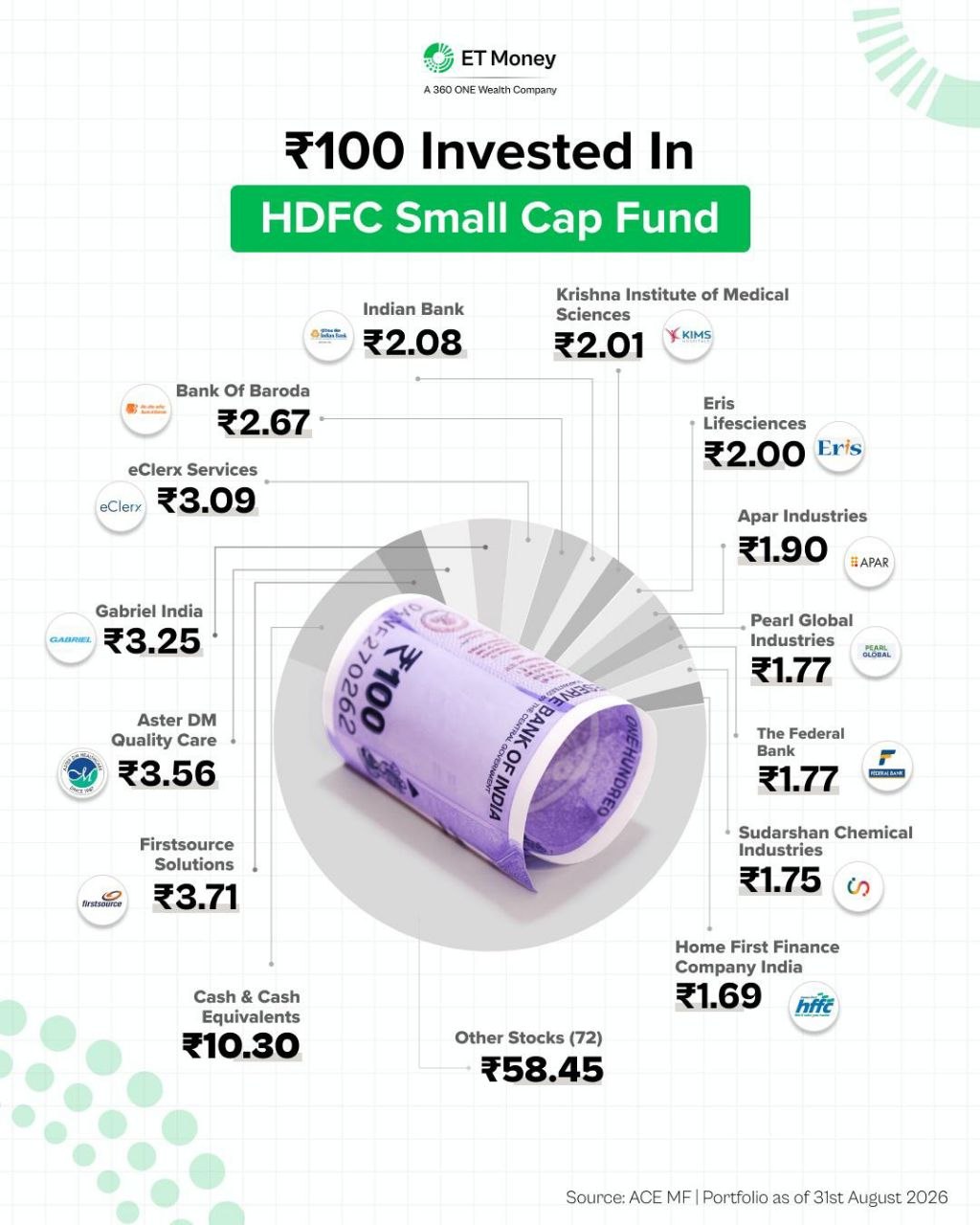
In an environment where domestic equities continue to navigate frothy valuations and heightened volatility in broader market segments, active fund managers are increasingly relying on cash buffers and broad diversification. According to portfolio analysis compiled by ET Money from ACE MF data, HDFC Small Cap Fund—one of India's largest small-cap equity schemes—allocated ₹10.30 out of every ₹100 invested to cash and cash equivalents.
The remaining ₹89.70 is deployed across 85 distinct stocks, demonstrating an intentionally fragmented portfolio designed to mitigate stock-specific risks in the inherently volatile small-cap arena. Strikingly, no single stock command more than ₹4 per ₹100 of total investment.
Top Holdings Reflect High Diversification
The fund's equity investments are led by IT-enabled services firm Firstsource Solutions, which accounts for ₹3.71 of every ₹100 invested. It is closely followed by healthcare provider Aster DM Quality Care at ₹3.56 and auto components maker Gabriel India at ₹3.25.
Key Individual Stock Allocations:
- Firstsource Solutions: ₹3.71
- Aster DM Quality Care: ₹3.56
- Gabriel India: ₹3.25
- eClerx Services: ₹3.09
- Bank of Baroda: ₹2.67
- Indian Bank: ₹2.08
- Krishna Institute of Medical Sciences (KIMS): ₹2.01
- Eris Lifesciences: ₹2.00
- Apar Industries: ₹1.90
- Pearl Global Industries: ₹1.77
- The Federal Bank: ₹1.77
- Sudarshan Chemical Industries: ₹1.75
- Home First Finance Company India: ₹1.69
Beyond these 13 leading names, the fund distributes ₹58.45 across 72 other stocks, underscoring fund manager Chirag Setalvad’s bottom-up approach that avoids oversized bets on any individual scrip.
Strategic Significance of the 10% Cash Pile
Holding over 10% in cash equivalents is a notable tactical strategy for a small-cap fund. In small-cap investing, sudden market drawdowns can dry up secondary market trading volumes rapidly. With mutual fund regulator Securities and Exchange Board of India (SEBI) maintaining rigorous scrutiny over small- and mid-cap fund liquidity profiles and stress tests, holding an adequate cash cushion serves dual purposes:
Managing Redemption Pressures: A liquid reserve ensures the fund can handle sudden redemption demands from retail and institutional investors without being compelled to sell less liquid small-cap holdings at distressed prices.
Preserving Dry Powder: Elevated cash levels give the investment team ammunition to deploy capital opportunistically into beaten-down, high-quality businesses during market pullbacks.
Implications for Mutual Fund Investors
HDFC Small Cap Fund’s asset allocation illustrates the realities of managing a large asset base in a small-cap mandate. As schemes grow past tens of thousands of crores in assets under management (AUM), taking large concentrated positions becomes difficult without running into substantial impact costs or crossing ownership limits.
For retail investors running Systematic Investment Plans (SIPs), this composition means returns are driven by broad sector participation rather than momentum in a handful of high-flying stocks. While holding double-digit cash during persistent market rallies can create a mild performance drag, it typically acts as a stabilizing shock absorber when market corrections hit the small-cap segment.
Tags: HDFC Mutual Fund SEBI Firstsource Solutions Aster DM Healthcare BSE 250 SmallCap Mutual Funds