
Elon Musk Targets Mukesh Ambani Over Starlink Approvals as Debate on Market Protectionism Intensifies — October 10, 2026
Published: 2026-10-10 09:38 IST | Category: Markets | By Flash Finance desk (written with AI assistance) · Editor: Kokila
A war of words between global tech billionaire Elon Musk and India’s domestic corporate giants has spilled onto the international stage, reigniting debates over regulatory fairness, market protectionism, and national sovereignty in critical digital infrastructure.
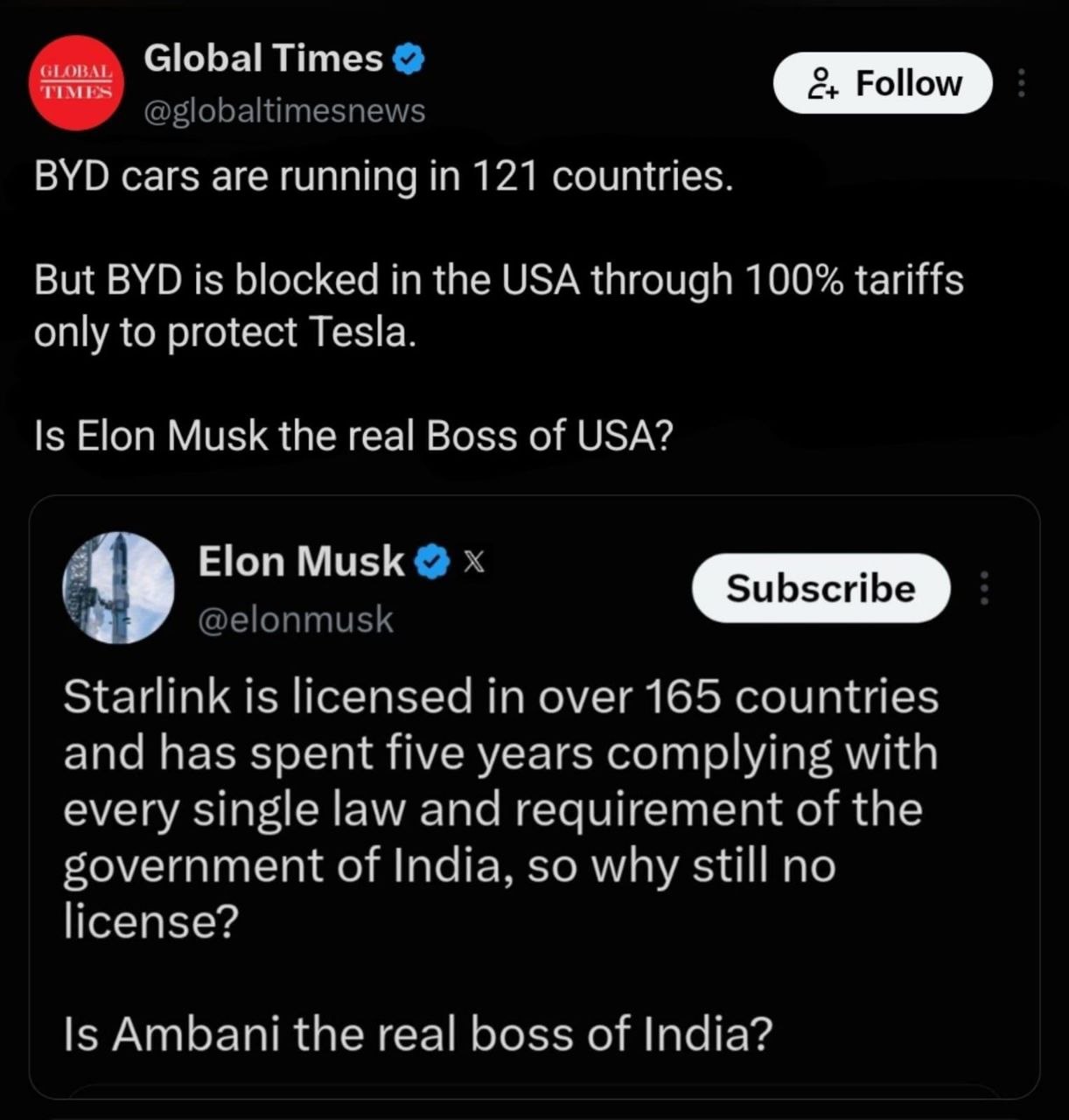
The controversy erupted after Musk took to social media platform X to question why Starlink has yet to receive final commercial clearance to operate in India, despite being licensed in over 165 countries and engaging with Indian authorities for five years. In a direct broadside, Musk accused unnamed "oligarchs" of maintaining a "monopolistic chokehold" on Indian consumers and pointedly asked whether Reliance Industries chairman Mukesh Ambani was "the real boss of India".
The remark swiftly drew an international counter-narrative, notably highlighted across social platforms and state-affiliated channels such as China’s Global Times, which turned Musk’s argument on its head. Critics pointed out that while Chinese electric vehicle giant BYD sells in over 120 nations, it remains effectively locked out of the United States by 100% tariffs intended to shield domestic manufacturers like Tesla, asking in kind whether Musk dictated American industrial policy.
New Delhi Dismisses Allegations of Favoritism
The Department of Telecommunications (DoT) and the Ministry of Communications moved rapidly to dismiss Musk’s claims as baseless and misconceived. The government clarified that India maintains a non-discriminatory, transparent authorization regime for all telecommunications and satellite communications providers.
While Starlink obtained its Global Mobile Personal Communication by Satellite (GMPCS) authorization, full commercial launch requires complete security compliance and final spectrum clearances overseen in conjunction with the Ministry of Home Affairs and space regulator IN-SPACe. Government officials emphasized that identical security protocols apply across all three primary license holders:
- SpaceX's Starlink: Received initial authorizations but remains subject to strict local data storage, network monitoring, and security audit clearances.
- Eutelsat OneWeb: Backed by Bharti Airtel, also progressing through regulatory security mandates ahead of broad commercial deployment.
- Jio Satellite Communications: A joint venture between Reliance Industries and Luxembourg-based satellite operator SES, governed by the same statutory checks.
Security concerns have taken precedence after sensitive equipment from unauthorized satellite setups was detected in border and conflict-sensitive areas in recent years. Indian regulators have maintained that sovereign security, intercept capabilities, and data residency cannot be bypassed for commercial speed.
The Domestic Battle: Spectrum Allocation and Market Dominance
Beyond the rhetoric, the confrontation reflects deep commercial tensions over the monetization of India's fast-growing satellite broadband sector.
The regulatory dispute initially centered around how satcom frequencies should be distributed. Reliance Jio had persistently advocated for a public auction mechanism, arguing that an administrative handout of airwaves would give foreign low-Earth orbit (LEO) satellite operators an unfair cost advantage over terrestrial telecom carriers that spent hundreds of thousands of crores at 4G and 5G spectrum auctions. In contrast, Starlink and Bharti Airtel favored administrative allocation in line with international International Telecommunication Union (ITU) practices.
While the Telecommunications Act of 2023 favored administrative allocation—an initial policy win for Starlink—the Telecom Regulatory Authority of India (TRAI) continues to evaluate pricing mechanisms and operational conditions.
Implications for Indian Investors
For investors on Dalal Street, the clash between SpaceX and domestic conglomerates highlights crucial structural dynamics:
Defending ARPU and Enterprise Turf Reliance Jio (with over 470 million telecom subscribers) and Bharti Airtel dominate Indian voice and mobile data. While consumer satellite broadband pricing remains prohibitive for the average retail consumer, satcom represents lucrative enterprise, defense, maritime, and rural backhaul business.
Pragmatic Partnerships Behind the Scenes Despite public barbs, commercial pragmatism often supersedes corporate posturing. Notably, both Reliance Jio and Bharti Airtel had earlier explored distributor agreements and network integration frameworks with Starlink to market satellite hardware in underserved interior belts, subject to statutory nods.
Policy Predictability and Foreign Capital While domestic regulatory thoroughness reassures security stakeholders, protracted clearance timelines remain a focal point for global tech firms assessing India's ease of doing business.
As New Delhi finalizes security conditions and TRAI formalizes satellite spectrum terms, Indian telecom investors will watch closely to see whether Starlink secures its final operating clearances or if the battle for India's digital skies faces prolonged regulatory entanglements.
Tags: Reliance Industries Bharti Airtel SpaceX Starlink Department of Telecommunications TRAI Telecom Sector
