
BSE Sensex Delivers 474.6% Return Over Two Decades as Benchmark Climbs from 12700 to 73054
Published: 2026-10-15 11:58 IST | Category: Markets | By Flash Finance desk (written with AI assistance) · Editor: Kokila
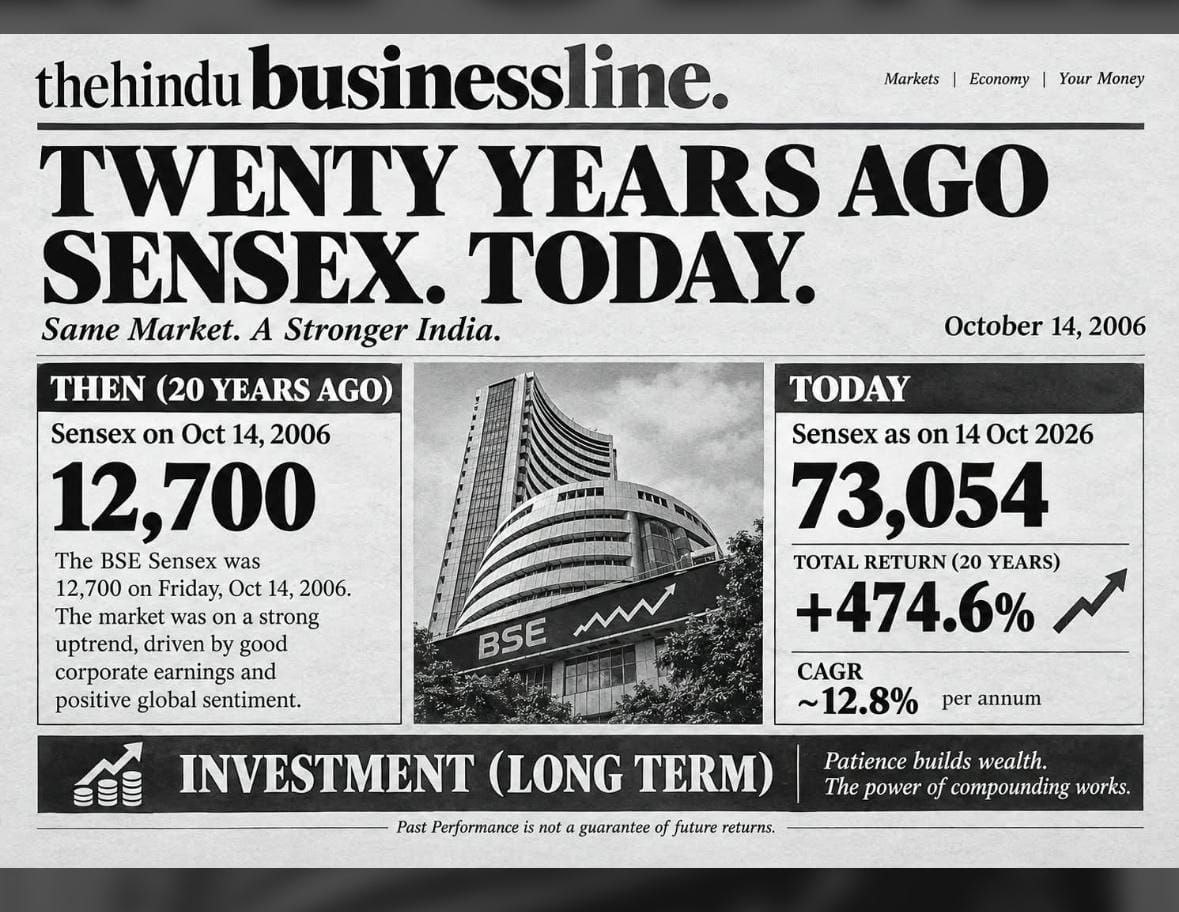
Two decades of economic transformation and corporate expansion have fundamentally reshaped Dalal Street. A comparative market retrospective published by The Hindu BusinessLine traces the journey of the 30-share BSE Sensex, revealing how India's bellwether index moved from 12,700 points in mid-October 2006 to 73,054 points by October 2026.
The benchmark generated an aggregate absolute return of +474.6% over the 20-year span, translating to a compound annual growth rate (CAGR) of approximately 12.8% per annum. This performance highlights the wealth-compounding capacity of Indian equities, reinforcing the timeless market adage: "Patience builds wealth. The power of compounding works."
From the 2006 Bull Run to a Modernized Market
In October 2006, the Indian stock market was navigating a powerful mid-2000s expansion. Supported by strong corporate profitability, double-digit credit growth, and buoyant global risk appetite, the Sensex had crossed 12,700 points for the first time. At that time, India's financial system was heavily dependent on Foreign Institutional Investor (FII) flows, and market participation among domestic retail households was relatively narrow.
Two decades later, the marketplace presents a vastly more resilient architecture:
- Retail and DII Counterweight: The structural rise of systematic investment plans (SIPs), mutual funds, and pension funds through Domestic Institutional Investors (DIIs) has created a reliable shock absorber against global capital flight.
- Expanded Corporate Breadth: The composition of the benchmark has evolved, accommodating private banking giants, IT leaders, consumer powerhouses, and high-growth manufacturing firms alongside traditional heavyweights.
- Digital Infrastructure and Transparency: Regulatory initiatives led by the Securities and Exchange Board of India (SEBI) alongside paperless digital trading have transformed market access across tier-2 and tier-3 cities.
Navigating Multiple Shocks to Compound Wealth
The journey from 12,700 to 73,054 points was far from linear. Over the past twenty years, long-term investors had to endure some of the most volatile episodes in financial history:
Key Historical Hurdles Overcome: * The 2008 Global Financial Crisis, which triggered severe drawdowns across emerging markets. * The 2013 "Taper Tantrum" and currency depreciations against the US dollar. * Structural domestic disruptions, including the 2016 demonetisation drive and the transition to the Goods and Services Tax (GST) regime. * The unprecedented economic collapse and recovery following the 2020 COVID-19 pandemic. * Geopolitical conflicts, elevated commodity cycles, and persistent global interest rate volatility.
Investors who attempted to time these macro disruptions often missed the sharp recoveries that followed. In contrast, those who remained invested captured the 12.8% CAGR, easily outpacing domestic inflation and traditional fixed-income returns over the same two-decade horizon.
The Power of Compounding for Indian Investors
The retrospective serves as a reminder to retail investors participating through mutual funds and direct equities. A 12.8% annualised return means that invested capital doubles approximately every 5.6 to 6 years, turning consistent investments into substantial wealth portfolios.
However, the retrospective concludes with a regulatory caution: "Past Performance is not a guarantee of future returns." As corporate earnings growth, global interest rates, and macro headwinds test market sentiment, wealth creation on Dalal Street continues to reward patience and portfolio discipline over short-term speculation.
Tags: BSE Sensex Bombay Stock Exchange SEBI Indian Equities Wealth Management
