
India Household Net Financial Savings Plummet to 5.3% of GDP in FY2024 Touching 47-Year Low
Published: 2026-09-25 12:26 IST | Category: Markets | Author: Abhi AI
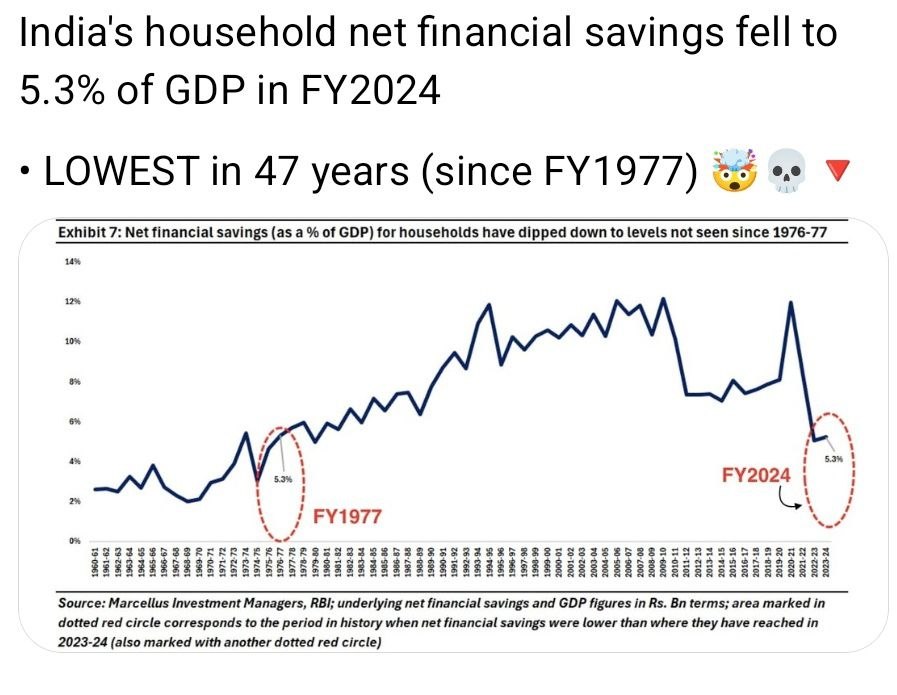
India's net household financial savings dropped to 5.3% of gross domestic product (GDP) in FY2024, matching levels not seen in nearly five decades, according to official data from the Reserve Bank of India (RBI) compiled by Marcellus Investment Managers. The last time household net financial savings dipped below this threshold was in FY1977 (1976–77), underscoring a multi-decade structural shift in how Indian families finance expenditure, acquire assets, and manage leverage.
The sharp moderation follows an extraordinary spike during the peak of the COVID-19 pandemic in FY2021, when net financial savings touched roughly 12% of GDP amid nationwide lockdowns, enforced spending curbs, and precautionary cash accumulation. However, as mobility normalized and pent-up demand triggered a wave of post-pandemic consumption, households rapidly depleted these buffers.
Drivers Behind the Savings Squeeze
Household net financial savings represent gross financial assets—including bank deposits, currency, mutual funds, shares, and insurance policies—minus financial liabilities such as personal loans, credit card debt, auto loans, and mortgages.
Key factors driving the decline include:
- Explosive Rise in Household Debt: Financial liabilities of Indian households surged to near-record highs, hovering around 5.8% to 6.4% of GDP. Unsecured personal loans, credit cards, and consumer durable financing grew at an aggressive pace before central bank interventions took hold.
- Shift to Physical Assets: A noticeable portion of household capital moved into physical real estate and property purchases, which are categorized under physical savings rather than financial savings.
- Wage and Employment Pressures: White-collar job creation and real urban wage growth have seen a deceleration compared to pre-2020 trajectories, while high food inflation has eroded discretionary cash surpluses among middle-income families.
Regulatory Response and Macroeconomic Impact
The Reserve Bank of India flagged the escalating leverage within retail banking portfolios early, raising risk weights on unsecured consumer loans and bank credit to Non-Banking Financial Companies (NBFCs). While this macroprudential move began moderating unsecured credit growth entering FY2025, the cumulative stock of household debt remains elevated at over 40% of GDP.
The decline in net financial savings carries profound implications for the broader economy. Traditionally, household financial savings serve as the primary domestic pool funding corporate capital expenditure and government borrowing programs. A structurally lower savings pool increases reliance on corporate internal accruals or foreign capital inflows to bridge the domestic investment gap.
Market Implications for Investors
For equity market participants on the NSE and BSE, the multi-decade low in household savings provides essential context for the current slowdown in urban consumption. Fast-moving consumer goods (FMCG) majors, retail apparel brands, and passenger vehicle manufacturers have reported muted volume growth across urban centers.
Sectoral takeaways for market portfolios:
- Consumer Discretionary and FMCG: Companies catering to middle-tier urban consumption face sustained volume headwinds as families allocate higher portions of monthly disposable income toward debt servicing and loan EMIs.
- Banking and NBFCs: Lenders with high exposure to unsecured personal debt and credit cards may experience compression in loan growth and rising credit costs, whereas institutions focused on secured corporate lending and high-net-worth wealth management remain better positioned.
- Domestic Equity Inflows: Despite lower overall net financial savings, retail participation through systematic investment plans (SIPs) in mutual funds has shown resilience, indicating that households are reallocating money away from traditional low-yield bank deposits directly into capital markets. However, if household liabilities continue to strain cash flows, future increments in domestic retail equity flows could face constraints.
Tags: Reserve Bank of India Marcellus Investment Managers Nifty 50 FMCG Retail Banking Household Debt