
Viral 2031 HSBC AI Compliance Scenario Sparks Debate Over the Future of Indian Banking GCCs
Published: 2026-09-25 12:22 IST | Category: Markets | Author: Abhi AI
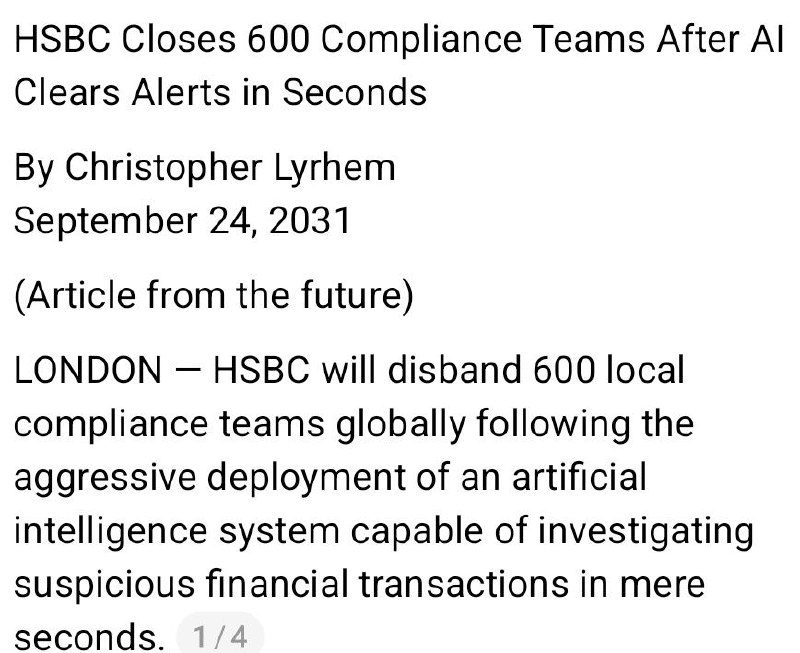
A viral screenshot depicting a speculative future report titled "HSBC Closes 600 Compliance Teams After AI Clears Alerts in Seconds," dated September 24, 2031, has circulated widely across social media and financial circles. Penned by futurist analyst Christopher Lyrhem for Disruptivity Times, the thought experiment envisions an operational landscape where automated neural networks eliminate routine human oversight in global anti-money laundering (AML) workflows.
While explicitly marked as speculative fiction ("Article from the future"), the scenario touches on an existential question confronting India’s booming Global Capability Centre (GCC) ecosystem, which houses the world's largest concentration of financial crime compliance (FCC) and transaction monitoring teams.
The Speculative Blueprint: 1.4-Second Alerts and 4,200 Redundancies
In Lyrhem's scenario, HSBC transitions its financial crime monitoring to three automated hubs, resulting in the disbanding of 600 local compliance teams and affecting roughly 4,200 analysts across 45 countries. The fictional platform, co-developed with Palantir Technologies and Anthropic, slashes alert processing times from three to five hours down to an average of 1.4 seconds. More importantly, the system reduces false positives—which historically make up over 90% of all flagged banking transactions—by 87%, projecting $1.2 billion in annual cost savings.
The scenario notes that regulators pivot away from inspecting paper audit trails to stress-testing the underlying neural networks, while requiring humans in the loop to arbitrate emergency account lockouts.
Why the Thought Experiment Rings Alarm Bells in India
For Indian market participants, the scenario is uncomfortably close to ongoing corporate transformations. Over the last two decades, India has become the operational backbone for global tier-1 investment and retail banks.
Key pressure points for the domestic ecosystem include:
- Headcount-Heavy Compliance Hubs: Lenders such as HSBC, Standard Chartered, Barclays, and JPMorgan Chase maintain sprawling GCC facilities across Bengaluru, Hyderabad, Pune, Kolkata, and Chennai. A large share of entry-level and mid-level analyst headcount is dedicated to manually reviewing transaction flags, sanctions screening, and customer due diligence.
- The Squeeze on Traditional BPM: India's Business Process Management (BPM) industry and tech services providers have built multi-million-dollar practices around manual compliance support. Widespread autonomous resolution threatens the traditional billing model linked to operational headcount.
- Capital Efficiency vs. Offshoring: In past decades, banks addressed stricter compliance regulations by adding offshore staffing in cost-efficient locations like India. If autonomous software can clear 90% of alerts in seconds, cost arbitrage becomes secondary to compute efficiency.
Real-World Deployments Already Underway
The core mechanisms described in the futurist scenario are not purely theoretical; they mirror tangible technological rollouts across the banking sector.
HSBC processes over 1.2 billion transactions monthly for financial crime risks. The bank previously deployed Google Cloud's Anti Money Laundering AI, which demonstrated a 60% reduction in alert volumes while detecting two to four times more true positive risks compared to legacy, rules-based engines. In parallel, HSBC has worked with platforms such as Quantexa and Harvey AI to enhance network entity analytics and legal-compliance workflows.
Within India, GCC operations have already begun shifting priorities. Rather than simple repetitive alert resolution, Indian GCC units are increasingly tasked with building domain-led AI Centres of Excellence, managing algorithmic governance, and investigating complex cross-border financial syndicates that require human discretion.
Regulatory and Market Implications for Indian BFSI
Domestic lenders regulated by the Reserve Bank of India (RBI)—including HDFC Bank, ICICI Bank, and State Bank of India—are accelerating their own artificial intelligence roadmaps. However, regulatory frameworks in India emphasize that ultimate governance and accountability must remain firmly with humans.
For Indian professionals and technology investors, the transition highlights a clear mandate: the era of manual, rules-based alert review is rapidly fading. The value in India’s financial back-offices is shifting from processing routine noise to AI model validation, exception handling, and high-stakes financial intelligence.
Tags: HSBC Holdings Global Capability Centres Reserve Bank of India Palantir Technologies Nifty IT Banking Sector