
Cup and Handle Pattern
A rounded base followed by a shallow drift — a long consolidation that resolves upward.
Shows the chart pattern on any stock we chart, or tells you there isn't one today.
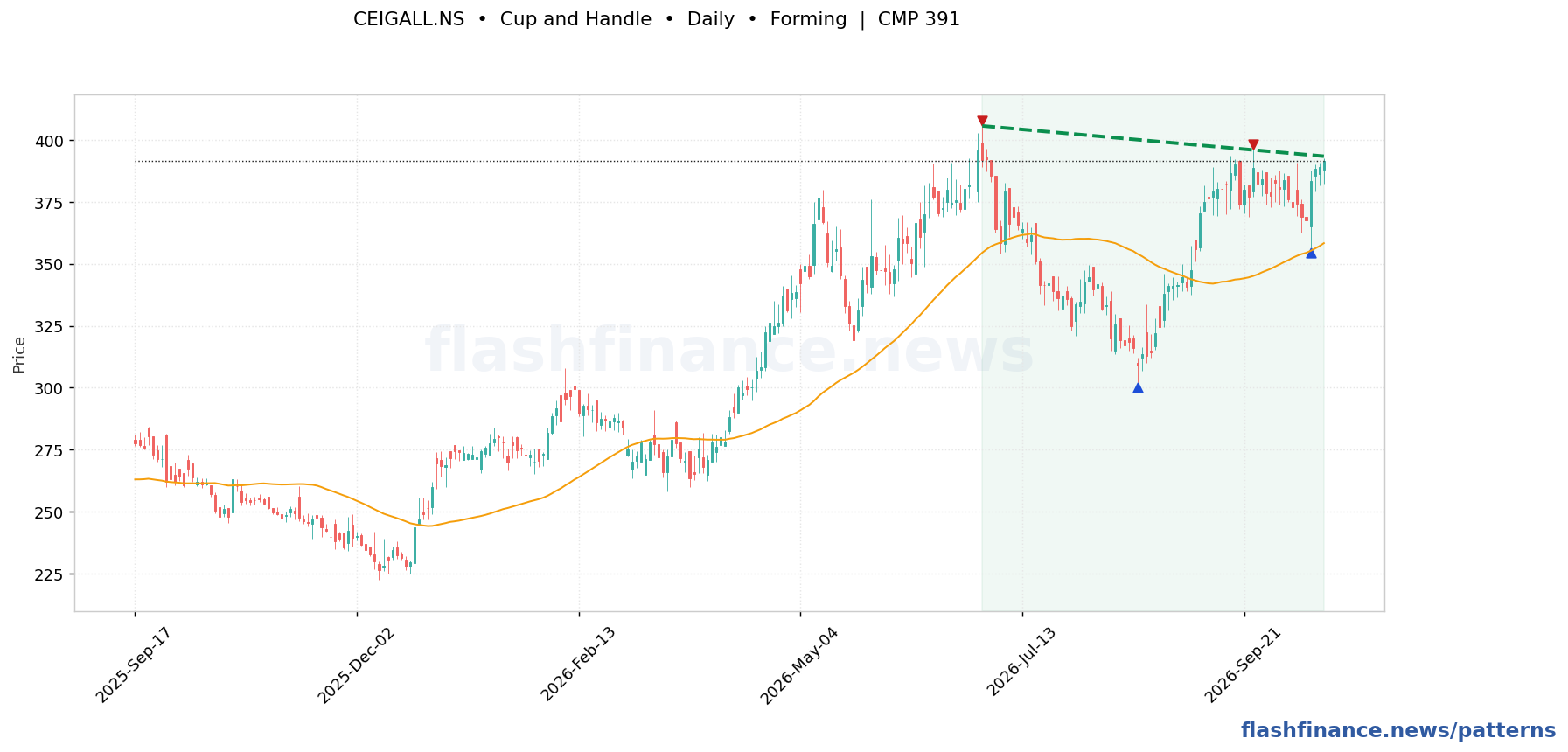
Showing 1 of 1. Trigger is the price a daily close must clear for the pattern to complete; Target is the measured move it projects, marked ≈ while the break has not happened yet.
| Stock | TF | State | CMP | Trigger | Away | Target | Touches |
|---|---|---|---|---|---|---|---|
| CEIGALLCeigall India Limited | Daily | Bullish | ₹391.45 | ₹393.46 | 0.5% | ≈₹492.01 (+26%) | 4 |
Price falls away, rounds out a broad U-shaped bottom, and comes back to the old high (the rim). It then drifts down modestly to form the handle before pushing through.
Why it forms
The cup is patient accumulation — the sharp sellers are long gone by the time the right side is built. The handle shakes out the impatient buyers who bought the recovery, leaving little supply above the rim.
🎯 Trigger
📏 Target
🛑 Invalidation
CEIGALL — Daily
What is a cup and handle pattern?
How deep should the handle be?
How long does a cup and handle take to form?
📚 Today's chart books (PDF)
About the chart books →Educational only. Prepared with AI assistance and reviewed by our editors; still check prices and levels yourself. Not investment advice.
How these are found: swing highs and lows are picked out with a percentage ZigZag on daily and weekly candles, and the boundaries are line-fitted through those swings. A formation is only published when the fit is tight, the boundaries are actually touched several times, and the price action stays inside them. The most recent swing is provisional, so a forming pattern can still change shape on the next candle, and patterns whose break already played out are dropped rather than shown as fresh. Levels and targets are the textbook measured moves, not forecasts. This is auto-generated market data, not investment advice.
