
Jio Platforms Looming Rs 37700 Crore Issue Redefines Indias Mega IPO League as Primary Market Scales New Peaks
Published: 2026-10-14 10:21 IST | Category: Markets | By Flash Finance desk (written with AI assistance) · Editor: Kokila
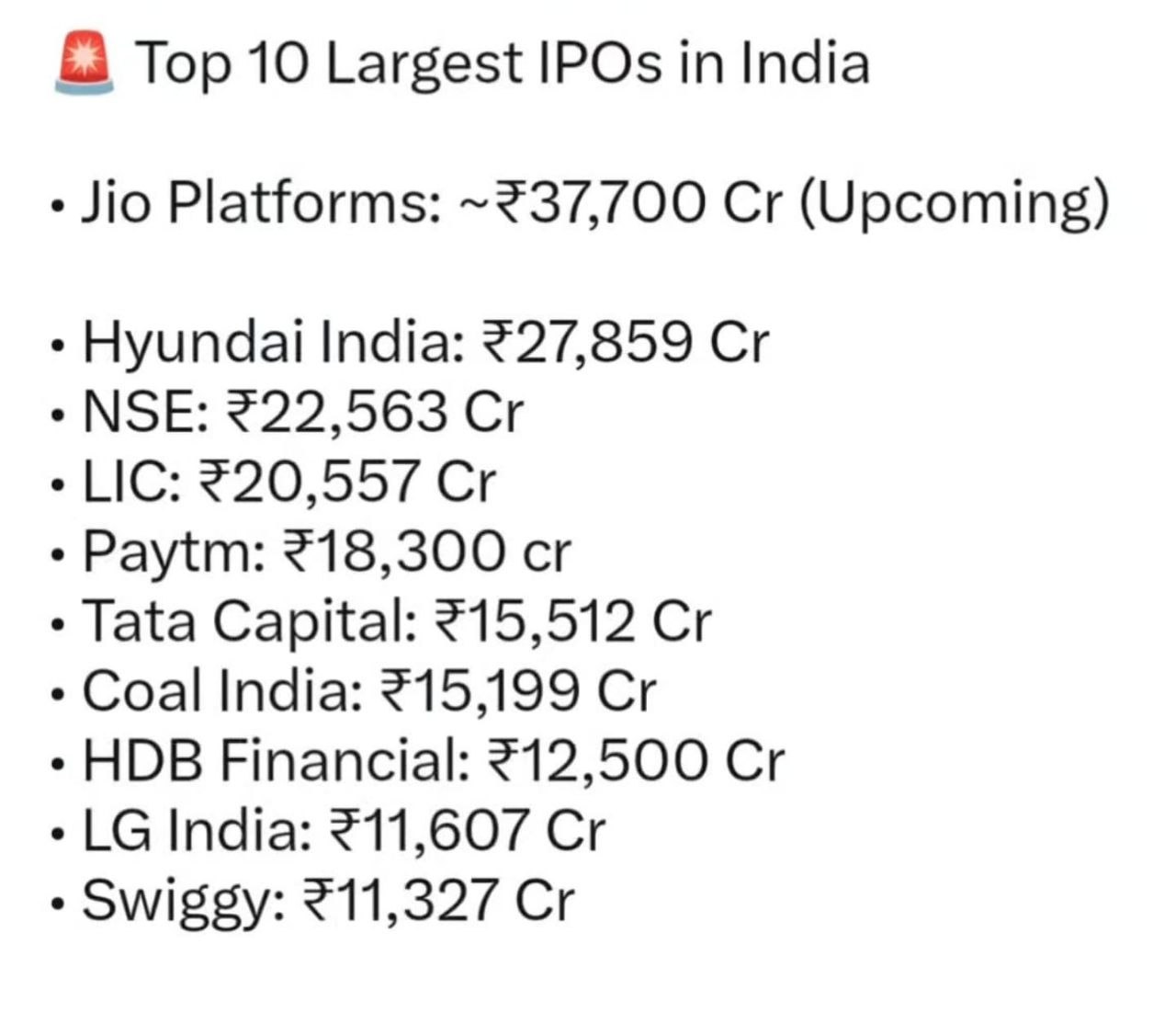
The Indian primary market is witnessing a structural transformation in deal sizes, evolving from an era where a ₹15,000-crore offering was a once-in-a-decade anomaly to an environment capable of absorbing multiple mega-issues exceeding ₹10,000 crore within single market cycles.
At the vanguard of this expansion is Jio Platforms, the digital and telecom flagship of Reliance Industries, which is lining up an unprecedented public offering estimated at ₹37,700 crore ($4 billion). If completed at this scale, the offering will decisively displace Hyundai Motor India's ₹27,859-crore landmark issue to claim the mantle of the largest IPO in Indian capital market history.
The Mega-Issue Hierarchy
The updated league table of India's largest public offerings reflects an expanding domestic capital pool, backed by robust institutional liquidity and steady systematic investment inflows from retail participants.
India's Top 10 Largest Public Offerings:
- Jio Platforms: ~₹37,700 crore (Upcoming)
- Hyundai Motor India: ₹27,859 crore
- National Stock Exchange (NSE): ₹22,563 crore
- Life Insurance Corporation of India (LIC): ₹20,557 crore
- Paytm (One97 Communications): ₹18,300 crore
- Tata Capital: ₹15,512 crore
- Coal India: ₹15,199 crore
- HDB Financial Services: ₹12,500 crore
- LG Electronics India: ₹11,607 crore
- Swiggy: ₹11,327 crore
The Shift from Disinvestment to Corporate Giants
Historically, landmark Indian issues were driven primarily by sovereign divestments or public sector undertakers. Coal India’s ₹15,199-crore listing in October 2010 held the record for the nation’s largest IPO for over a decade. When the government offloaded a 3.5% stake in state insurer LIC in May 2022 to raise ₹20,557 crore, it underscored the state's reliance on primary markets to monetize marquee assets.
However, the recent wave marks a definitive pivot toward multinational subsidiaries, conglomerates, and top-tier financial institutions: 1. Multinational Monetization: Global giants like Hyundai Motor Company and LG Electronics have unlocked deep valuations in their Indian arms, capitalizing on India's premium consumer markets. 2. Regulatory Mandates: Non-banking financial companies (NBFCs) classified in the Reserve Bank of India’s (RBI) "Upper Layer"—including HDB Financial Services (₹12,500 crore) and Tata Capital (₹15,512 crore)—have advanced listing timelines to satisfy central bank governance criteria. 3. Market Infrastructure: The long-anticipated listing of the National Stock Exchange (NSE) at ₹22,563 crore creates an equity benchmark for domestic exchange infrastructure.
Valuation Realities: The Listing-Day Paradox
For Indian retail and high-net-worth investors, headline deal volume has rarely guaranteed instant listing rewards.
A critical pattern across India's largest issues reveals significant post-listing divergence: * The Discount Club: Hyundai Motor India fell 5.87% on debut, while LIC tumbled over 7% and Paytm suffered a steep 27.4% discount on its first day of trading. * The Conservative Outlier: Coal India remains one of the few mega-issues that generated massive debut wealth, gaining roughly 40% on its listing day in 2010 due to conservative pricing.
Market participants highlight that large offerings often face liquidity drag when dominated purely by an Offer for Sale (OFS), where capital flows directly to promoters rather than strengthening company balance sheets. Hyundai India’s ₹27,859-crore issue was a 100% OFS, leaving the operational entity with no fresh capital.
In contrast, Jio Platforms' DRHP details propose an issue comprising fresh equity shares. The company plans to allocate approximately ₹27,500 crore of the proceeds directly toward prepaying borrowings at its primary subsidiary, Reliance Jio Infocomm Limited (RJIL), significantly improving its capital structure.
What This Means for Dalal Street
The concentration of five-figure crore public issues indicates that the Indian equity ecosystem has matured to absorb institutional allotments of global magnitude without destabilizing secondary-market indices.
Nonetheless, with domestic mutual funds and retail investors facing an unprecedented supply of fresh paper, pricing discipline will remain the ultimate arbiter between sustainable long-term wealth creation and short-term listing overhangs.
Tags: Jio Platforms Hyundai Motor India National Stock Exchange Life Insurance Corporation of India SEBI Primary Markets
