
Maruti Suzuki Dominates Passenger Vehicle Retails With 1.69 Lakh Units as Mahindra Edges Tata by 89 Cars
Published: 2026-10-19 11:16 IST | Category: Markets | By Flash Finance desk (written with AI assistance) · Editor: Kokila
India's passenger vehicle retail registrations recorded an all-time monthly high for September, reaching 4,27,213 units and advancing 32.10% year-on-year from 3,23,391 units in September 2025, according to official registration data compiled by the Federation of Automobile Dealers Associations (FADA). Month-on-month volumes expanded 6.17% over the 4,02,398 units registered in August 2026.
While market leader Maruti Suzuki retained an unassailable volume buffer at the top, the most intense battle unfolded in the runner-up position, where Mahindra & Mahindra overtook Tata Motors by a mere 89 vehicles.
September 2026 Retail Sales Hierarchy
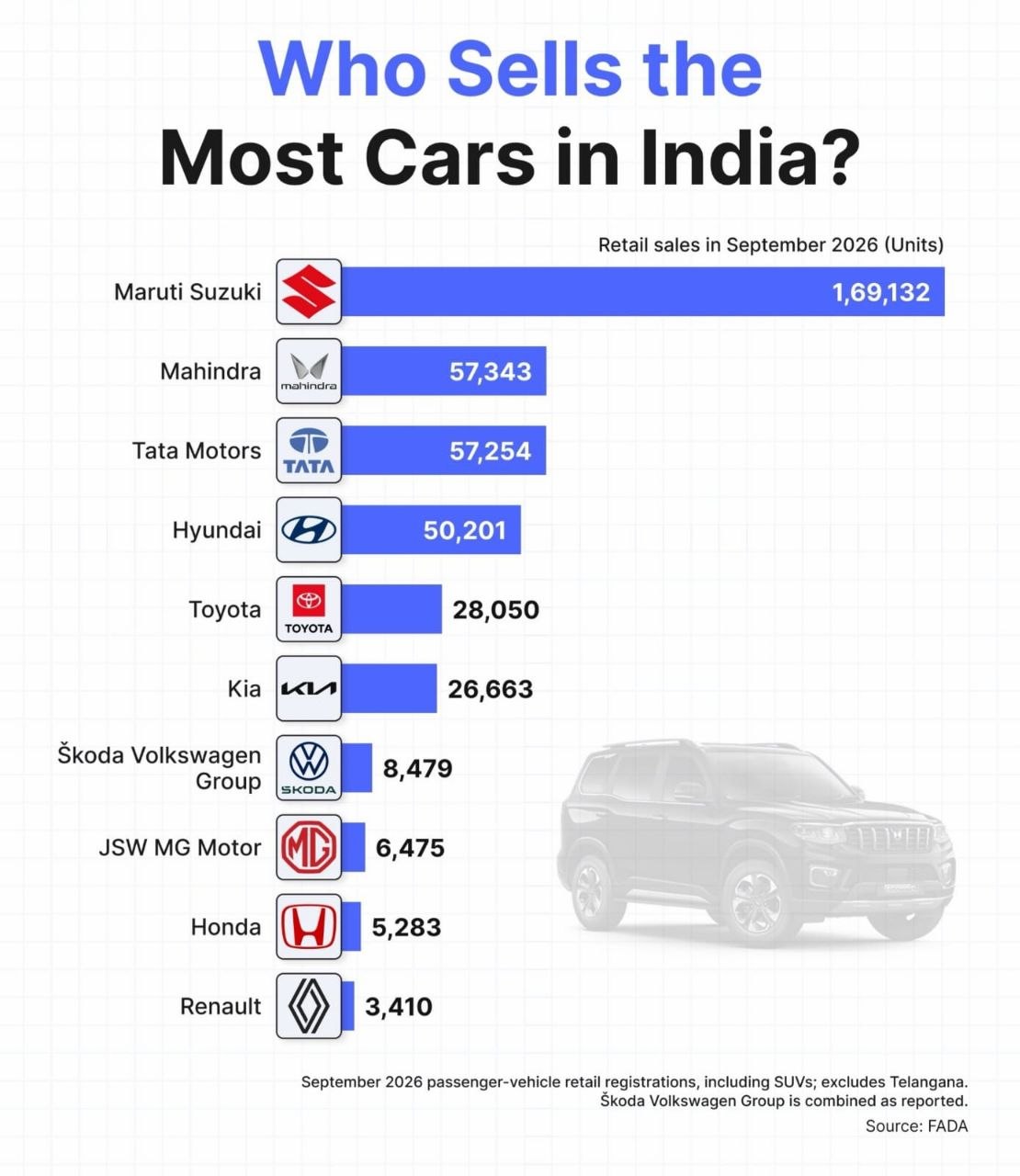
According to FADA retail data (which covers customer registrations and excludes Telangana), the manufacturer standings for the month were:
- Maruti Suzuki: 1,69,132 units (39.59% market share)
- Mahindra & Mahindra: 57,343 units (13.42% market share)
- Tata Motors: 57,254 units (13.40% market share)
- Hyundai Motor India: 50,201 units (11.75% market share)
- Toyota Kirloskar Motor: 28,050 units (6.57% market share)
- Kia India: 26,663 units (6.24% market share)
- Škoda Volkswagen Group: 8,479 units (1.98% market share)
- JSW MG Motor: 6,475 units (1.52% market share)
- Honda Cars India: 5,283 units (1.24% market share)
- Renault India: 3,410 units (0.80% market share)
Maruti Suzuki Extends Absolute Volume Lead
Maruti Suzuki India continued to retail more passenger vehicles than the second-, third-, and fourth-placed manufacturers combined. Its September tally of 1,69,132 units reflected a 30.05% year-on-year increase from 1,30,049 units registered in September 2025. Although the company's retail market share softened marginally from 40.21% a year ago to 39.59%—as total industry sales expanded at a slightly faster 32.10% clip—it posted steady sequential traction of 2.38% over August.
The Fight for Second Place: Mahindra Pips Tata
The standout corporate shift in the September data was Mahindra & Mahindra’s displacement of Tata Motors for the number two spot. Driven by sustained appetite across its SUV lineup—including the Scorpio N, Scorpio Classic, Thar, and XUV family—Mahindra recorded 57,343 retail units, registering a 38.93% year-on-year surge and a 14.13% month-on-month rebound. This lifted Mahindra's retail market share to 13.42%.
Tata Motors settled into third place at 57,254 units, expanding 28.66% year-on-year from 44,499 units but retreating 1.02% sequentially. The resulting margin—just 89 units or 0.02 percentage points in market share—demonstrates how tight the battle for second place has become.
Hyundai Motor India captured fourth position with 50,201 registrations, achieving 31.46% year-on-year growth and commanding an 11.75% share of the market.
Macro Drivers, Base Effect, and Inventory Realities
While headline growth figures surpassed 32% year-on-year, FADA noted that annual comparisons were magnified by a distorted base in September 2025, when buyers delayed showroom deliveries ahead of key tax transitions under GST 2.0.
On a broader operational level:
- Geographic Parity: Demand expanded evenly across geographies, with urban passenger vehicle registrations rising 32.11% and rural markets growing 32.09% year-on-year.
- Powertrain Dynamics: Petrol/ethanol models retained an edge at 41.27% of passenger vehicle retail, closely tracked by alternative fuels (CNG, hybrids, and electric vehicles) at 41.00%. Electric vehicle adoption reached 8.45%, while hybrid vehicles commanded 9.44%.
- Channel Inventory: Dealership passenger vehicle inventory was estimated at 43 to 45 days of sales heading into the high-demand festive window, representing a moderate build-up compared to standard benchmarks.
Market Implications for Auto Investors
For public market investors tracking domestic original equipment manufacturers (OEMs), the September registrations present important takeaways. Retail registrations reflect genuine end-customer demand, free from the distortions of wholesale factory dispatches that can artificially swell dealer channels.
Mahindra’s sustained outperformance highlights the high margins and resilient demand embedded in dedicated SUV lineups. Concurrently, Tata Motors' multi-powertrain strategy spanning petrol, diesel, CNG, and EVs keeps the OEM in dead-heat contention. As dealership stock remains elevated ahead of Dhanteras and Diwali deliveries, investor attention will pivot toward inventory liquidation rates and discounting pressures during the final quarter of the calendar year.
Tags: Maruti Suzuki India Mahindra & Mahindra Tata Motors Hyundai Motor India FADA Automobile Sector
