
331,602 Indian Students in US Ignite Debate Over Brain Drain and Domestic Tech Valuation
Published: 2026-10-23 18:49 IST | Category: Markets | By Flash Finance desk (written with AI assistance) · Editor: Kokila
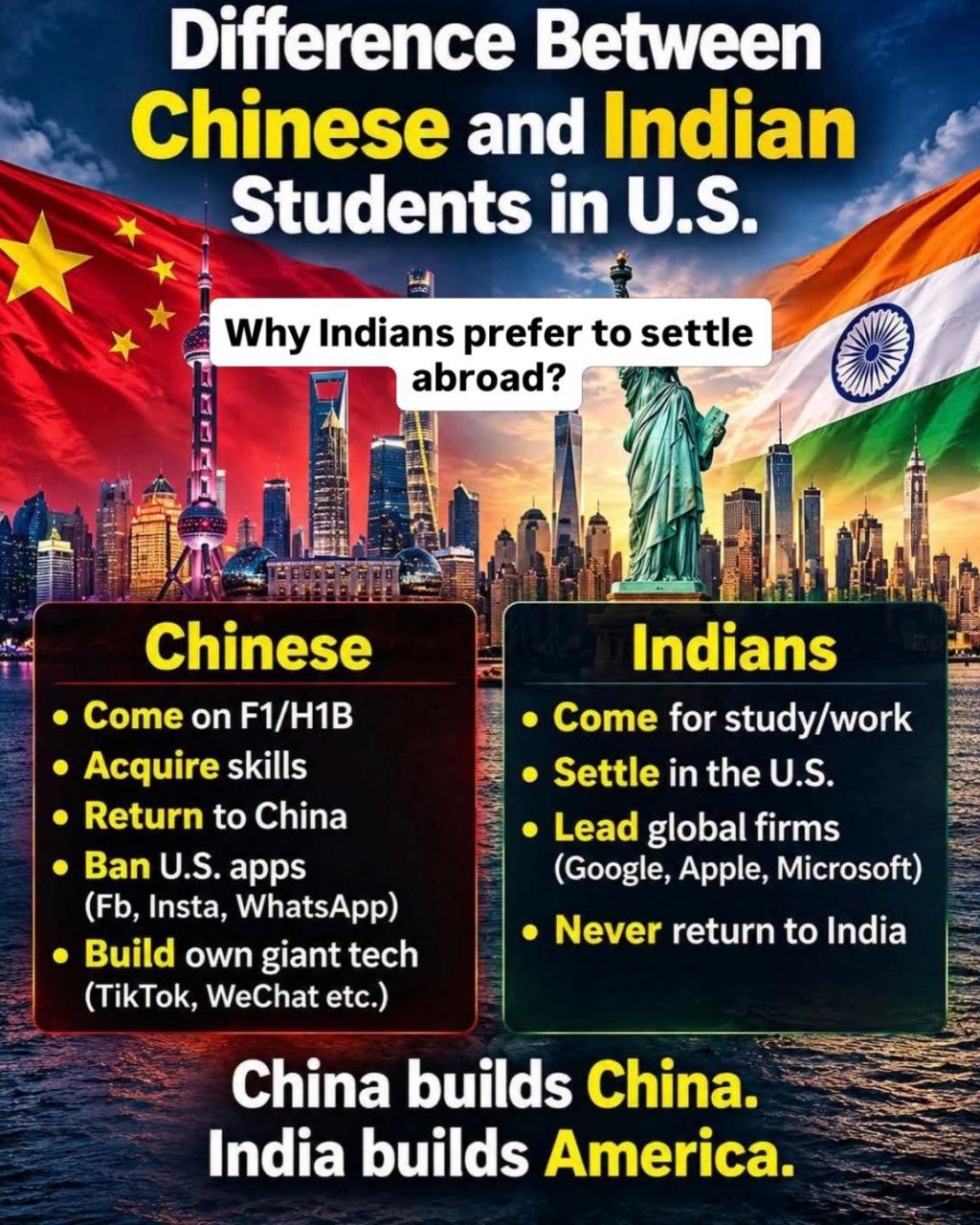
A graphic circulating across professional networks contrasting the trajectories of Chinese and Indian students in the United States—concluding with the assertion that "China builds China; India builds America"—has sparked intense discussion across India's technology hubs and investor communities.
The visual contrast highlights two distinct models of international mobility: Chinese scholars who acquire technical skills in the West before returning home to develop sovereign technology ecosystems such as ByteDance (TikTok) and Tencent (WeChat) behind protective regulatory barriers, versus Indian students who secure degrees, transition to corporate tracks, and lead US-headquartered tech giants such as Alphabet and Microsoft while permanently residing abroad.
Open Doors Data Confirms the Demographic Shift
The debate is underpinned by shifts in migration statistics. According to the Open Doors 2024 Report published by the Institute of International Education (IIE), India officially surpassed China as the leading place of origin for international students in the US for the first time in 15 years.
Key figures from the report highlight the operational scale of this influx:
- India sent 331,602 students to the US during the 2023/24 academic year, an increase of 23% from the previous period.
- China recorded 277,398 students in the US over the same cycle, representing a decline of 4%.
- Indian students heavily concentrated in graduate studies (196,567 students) and Optional Practical Training (OPT), which jumped 41% to 97,556 individuals.
- By contrast, Chinese participation in OPT stood at 61,552, with a notable presence remaining at the undergraduate level (87,551).
The high proportion of Indian students enrolling in STEM degrees and transitioning immediately into OPT underscores a career pipeline engineered toward employment in Silicon Valley, sponsored H-1B visas, and long-term US residency.
The Brain Drain and Capital Outflow Conundrum
For the Indian macroeconomy, this student outflow represents both a financial and intellectual drain. Under the Reserve Bank of India's (RBI) Liberalised Remittance Scheme (LRS), resident individuals are permitted to remit up to $250,000 per financial year, with education abroad consistently ranking among the single largest outward forex drawdowns under the scheme. Billions of dollars in household savings are exported annually to fund tuition and living expenses at American universities.
While non-resident Indian (NRI) remittances provide strong current account support, the loss of premier engineering and scientific talent deprives the domestic economy of high-end product innovation. While Indian executives command trillion-dollar enterprise valuations abroad, the domestic technology index (Nifty IT) remains predominantly populated by IT services contractors—such as Tata Consultancy Services and Infosys—that trade at lower valuation multiples than US-based product companies and artificial intelligence platforms.
China’s Repatriation Model versus India’s Service Economy
The stark contrast drawn in the visual mirrors decades of divergent national tech policies. China used rigorous market access curbs on US consumer platforms—blocking Google, Meta's Facebook and Instagram, and WhatsApp—to create a protected domestic arena where returning engineers, colloquially termed haigui ("sea turtles"), built parallel digital giants.
India, by contrast, remained an open, consumption-driven market for Western Big Tech. Although Indian engineers form the operational backbone of global software design, the intellectual property (IP), parent equity, and primary capital gains remain locked in Delaware-registered corporations.
Implications for Indian Capital Markets
For domestic asset managers and venture capital funds, bridging this talent divide is becoming a structural priority:
- Rise of Global Capability Centres (GCCs): Over 1,600 multinational GCCs currently operate across Bengaluru, Hyderabad, and Pune, increasingly taking on high-complexity core engineering rather than low-end maintenance.
- Immigration Headwinds: Severe green card backlogs and tightening work-visa caps in the US are compelling mid-career tech professionals to reconsider returning to India or establishing cross-border deep-tech startups at home.
- Deep-Tech Domestic Funding: Retaining top engineering graduates requires deep institutional risk capital in semiconductor design, artificial intelligence, and enterprise software—areas where Indian public markets have historically lagged behind US venture capital ecosystems.
As India seeks to transition from an IT services hub into a creator of frontier technology, the conversation prompted by foreign student flows is shifting from diaspora pride to an urgent domestic economic policy mandate.
Tags: Reserve Bank of India Alphabet Microsoft IT Services Nifty IT Venture Capital
