
Global Tech Forward Earnings Up 408% Outpace Price Rallies in Sharp Contrast to Dot-Com Bubble
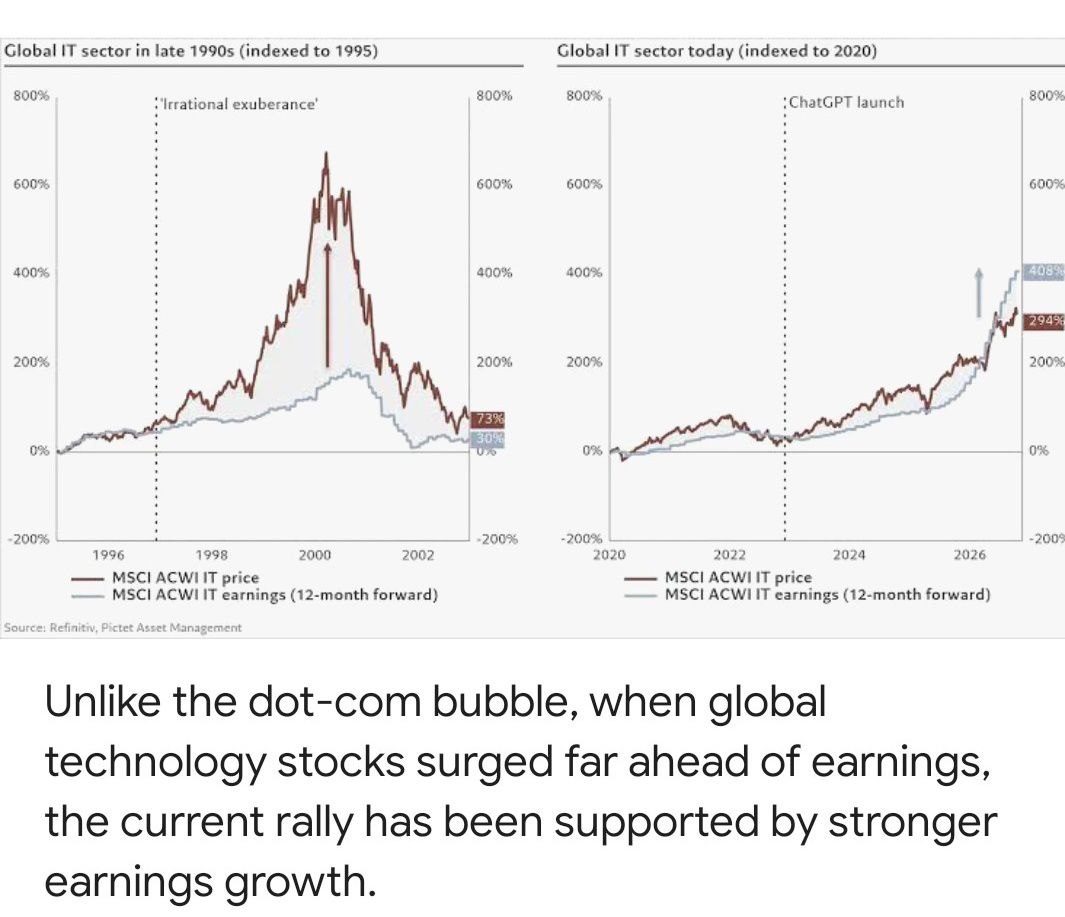
An analysis comparing the dot-com era of the late 1990s with today's artificial intelligence-driven technology cycle shows that current market advances are grounded in tangible corporate profitability rather than speculative exuberance.
According to data compiled by Refinitiv and Pictet Asset Management tracking the MSCI ACWI Information Technology Index, forward earnings growth has outstripped equity valuations since 2020. This dynamic marks a complete structural reversal from the 1995–2002 market bubble.
Earnings Take the Wheel: 2020s vs. Late 1990s
Between 1995 and 2000, following the famed "irrational exuberance" period, the MSCI ACWI IT price index surged more than 600%, while 12-month forward earnings struggled to keep pace. When the bubble burst, lack of underlying cash flows triggered an aggressive collapse, pulling the index's price down to 73% and forward earnings to 30% by 2002. During that era, roughly 36% of large-cap tech companies operated without profitability, relying on venture capital and equity issuance.
By contrast, the cycle indexed from 2020 presents an entirely different trajectory:
- Earnings Lead the Rally: Following the launch of ChatGPT in late 2022, global IT 12-month forward earnings surged to 408%.
- Controlled Valuations: The MSCI ACWI IT price index rose to 294%, trailing earnings expansion rather than outrunning it.
- Balance Sheet Health: Today, only about 20% of tech firms are unprofitable, with leading technology conglomerates funding capital expenditures out of strong operating cash flows.
What This Means for Dalal Street and Indian IT
For Indian market participants, the divergence offers substantial relief against persistent fears that global AI hype could precipitate a crash similar to the year 2000. The domestic software sector has undergone periods of volatility amid shifting global capital allocation, but the solid earnings backdrop has provided a firm floor.
The Nifty IT index delivered a sharp rebound of approximately 17% in October, demonstrating that investors view India's IT export giants as cash-generative, defensive plays during times of AI hardware recalibration.
Key Domestic Performance Metrics:
- Tata Consultancy Services (TCS): The IT heavyweight disclosed that its annualised AI revenue crossed $3.1 billion, accounting for more than 10% of total revenue, while posting a 15% rise in quarterly net profit.
- HCLTech: The firm booked record deal wins of $3.3 billion, increased the lower end of its FY27 constant-currency revenue guidance to 2.5%, and saw its advanced AI revenue climb 78% year-on-year to $219 million.
- Infosys: The Bengaluru-based bellwether expanded AI-related revenue by 29% quarter-on-quarter to represent 10.5% of total revenue, backed by $5.2 billion in large deal bookings.
A Less Capital-Intensive AI Play
Unlike global hyperscalers and semiconductor designers that face escalating scrutiny over heavy capital expenditure, Indian software services companies act primarily as enterprise implementation partners. This positioning allows Tier-1 Indian IT firms to participate in enterprise adoption cycles without taking on large-scale infrastructure debt.
Trading at historical forward multiples of 12 to 18 times earnings and offering dividend yields between 3% and 5%, Indian IT majors present reasonable valuation cushions. As historical data confirms that global tech valuations remain anchored in real forward earnings, Indian technology portfolios remain tied to secular digitisation and execution rather than unbacked narrative speculation.
