
Nvidia Surges 31.57% to $165.06 as Jensen Huang Reinstated as CEO, Sparking Relief Rally for Indian Tech Investors
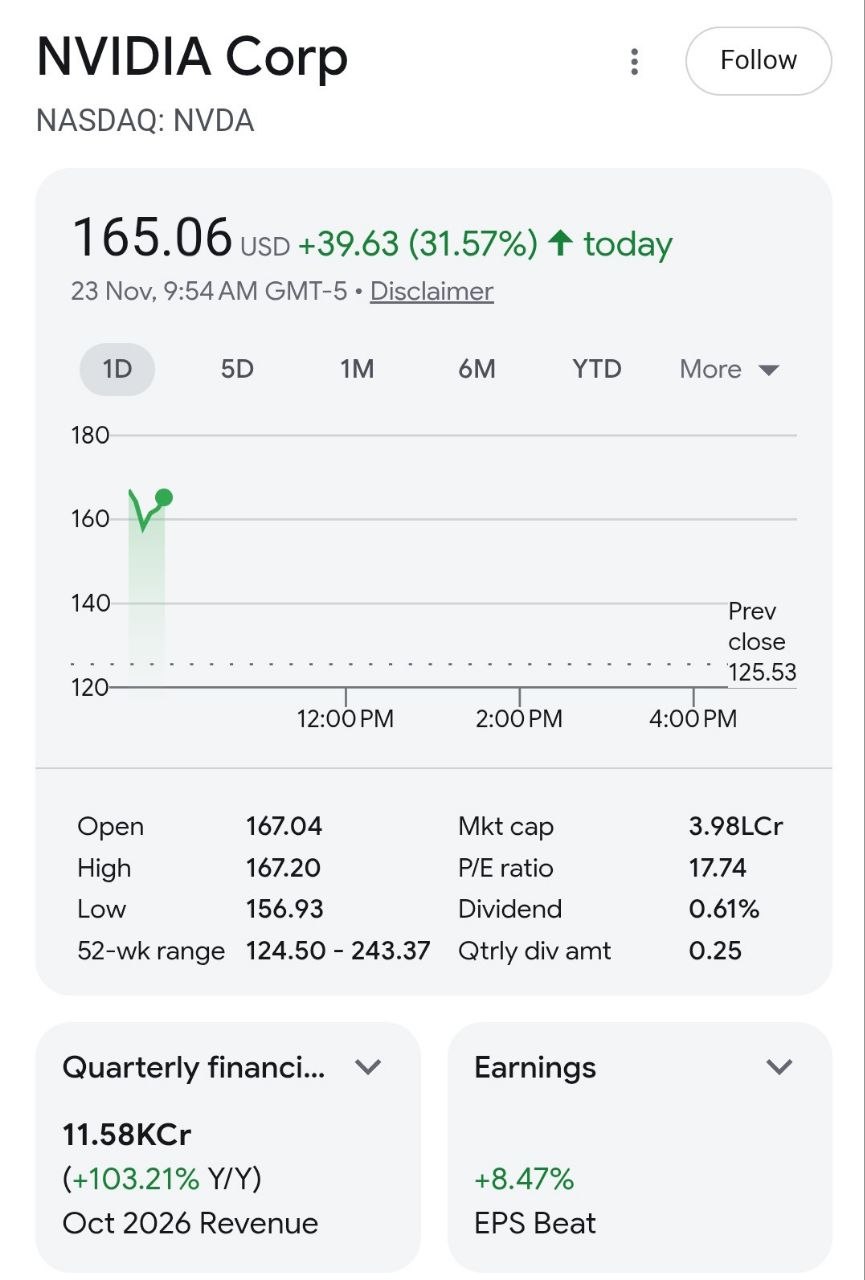
Semiconductor giant NVIDIA Corp (NASDAQ: NVDA) surged by 31.57% during early trading on November 23, jumping $39.63 to reach $165.06 as of 9:54 AM GMT-5. The sudden upswing marked one of the sharpest single-day rebounds for the company, following an extraordinary session where the stock opened at $167.04, touched a day high of $167.20, and traded above an intraday low of $156.93.
The dramatic rebound comes after Nvidia closed at $125.53 on the preceding trading session, hitting a 52-week low of $124.50 amid intense corporate governance and regulatory turbulence. Monday's rally effectively added hundreds of billions of dollars back to Nvidia’s valuation, taking its market capitalisation to $3.98 trillion (displayed as 3.98 lakh crore USD in domestic trading dashboards).
Reinstatement of Jensen Huang Calms Markets
The catalyst for the historic buying momentum was Nvidia’s decision to reinstate co-founder Jensen Huang to the helm as Chief Executive Officer. The stock had fallen nearly 14% on Friday and had shed more than 23% over the prior week after leadership uncertainties, independent inquiries, and reports of regulatory scrutiny by the US Securities and Exchange Commission (SEC) rattled Wall Street.
The return of Huang settled immediate fears surrounding leadership continuity at the world’s preeminent AI infrastructure company. Despite recent turbulence, Nvidia’s underlying financials demonstrated explosive growth, highlighted by its October 2026 quarter revenue print of $115.8 billion (11.58K crore USD), up 103.21% year-on-year, alongside an 8.47% earnings per share (EPS) beat. The stock currently trades at a price-to-earnings (P/E) ratio of 17.74 with a dividend yield of 0.61%.
Direct Implications for Indian Investors and Dalal Street
The sharp recovery in Nvidia reverberated strongly across Indian financial markets:
- Relief for International Mutual Funds and ETFs: Indian retail and high-net-worth investors holding exposure to US equities via the Liberalised Remittance Scheme (LRS) or domestic feeder schemes—such as the Motilal Oswal Nasdaq 100 ETF, Mirae Asset NYSE FANG+ ETF, and international tech funds—stand to recoup significant portfolio value after absorbing steep drawdowns over the preceding week.
- Sentiment Boost for Indian IT Services: Indian technology bellwethers on the Nifty IT index, including Tata Consultancy Services (TCS), Infosys, Wipro, and HCLTech, have heavily tied their forward cloud transformation pipelines to enterprise generative AI deployments running on Nvidia architectures. Stability at Nvidia provides reassurance for ongoing enterprise AI capital expenditure budgets globally.
- Domestic AI Infrastructure Alliances: Conglomerates such as Reliance Industries and the Tata Group, which have announced large-scale partnerships with Nvidia to build sovereign AI supercomputing data centers across India, benefit from strategic certainty at Nvidia's executive level.
While ongoing inquiries by regulators such as the SEC remain on investors' radars, the decisive leadership resolution and the subsequent 31% rally have injected fresh optimism into global technology equities, providing a tailwind for domestic benchmarks including the Nifty 50 and BSE Sensex.
