
UPI Annual Volumes Surge 262-Fold to 24,162 Crore Transactions in FY26 as Daily Runs Hit 66 Crore
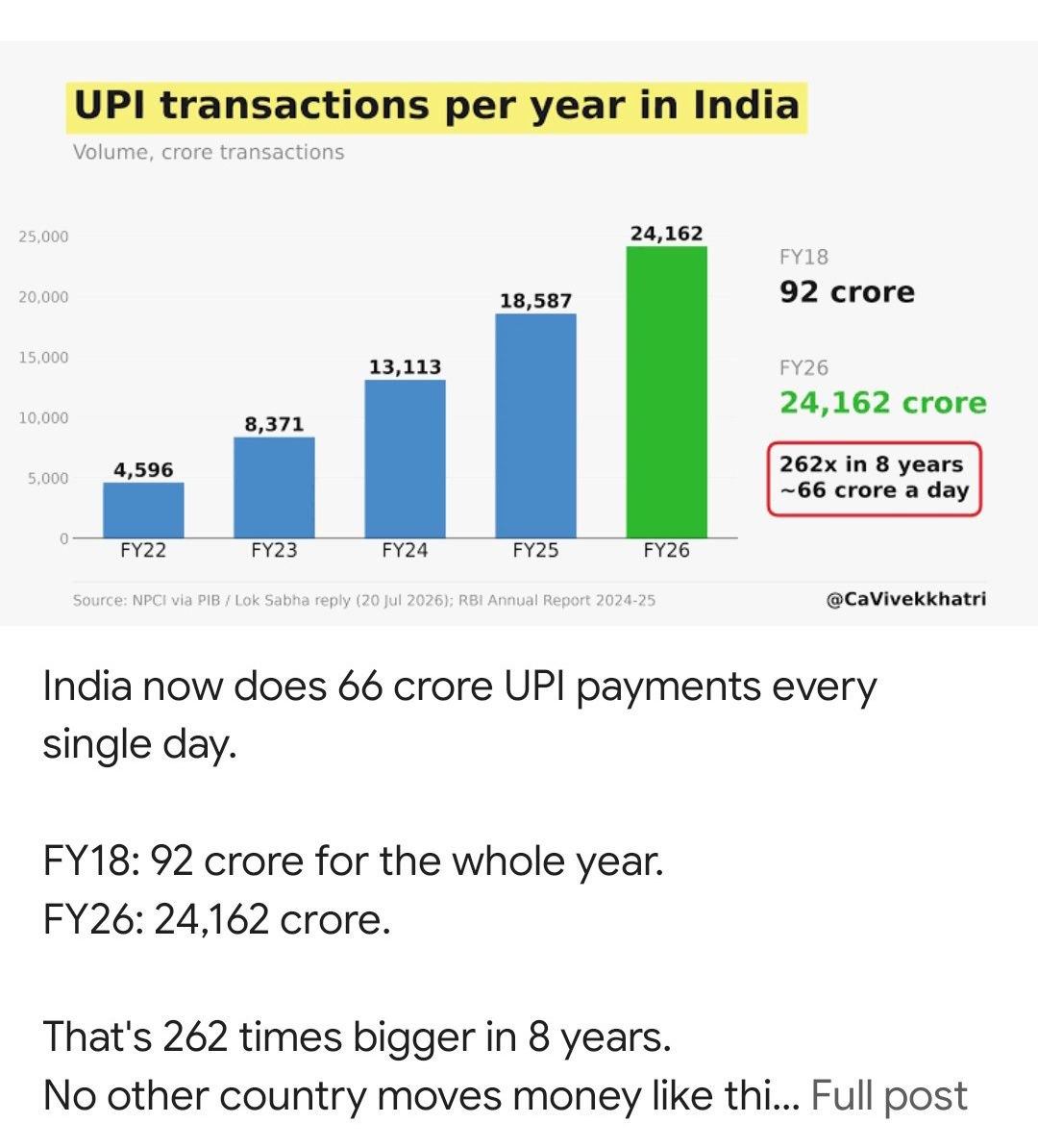
India’s Unified Payments Interface (UPI) has rewritten global benchmarks for real-time payment systems, scaling to an unprecedented 24,162 crore transactions in the financial year 2025–26 (FY26). The volume represents a staggering 262-fold increase from just 92 crore transactions recorded in FY18, demonstrating a compounding digital infrastructure shift that now clocks approximately 66 crore transactions every day.
According to data presented by the Minister of State for Finance, Pankaj Chaudhary, in a written reply to the Lok Sabha, the total value settled over the platform reached ₹314.23 lakh crore in FY26, up from ₹84.16 lakh crore in FY22 and just ₹1.10 lakh crore in FY18. By June 2026, the registered user base across UPI applications crossed 55.49 crore individuals.
Year-on-Year Growth Trajectory
The five-year trajectory illustrates sustained volume expansion even as the base grew exponentially:
- FY22: 4,596 crore transactions valued at ₹84.16 lakh crore
- FY23: 8,371 crore transactions valued at ₹139.15 lakh crore
- FY24: 13,113 crore transactions valued at ₹199.95 lakh crore
- FY25: 18,587 crore transactions valued at ₹260.56 lakh crore
- FY26: 24,162 crore transactions valued at ₹314.23 lakh crore
While the percentage rate of growth has naturally moderated from the triple-digit compound annual growth rates seen in earlier years, absolute incremental volumes have expanded consistently. In FY26 alone, the network absorbed over 5,575 crore additional transactions compared to the prior fiscal year.
Shift Toward Merchant Ecosystems and Small-Ticket Adoption
A defining pillar of UPI’s runaway adoption has been the penetration of Person-to-Merchant (P2M) transactions. Supported by the Reserve Bank of India’s (RBI) Payments Infrastructure Development Fund (PIDF) and zero merchant discount rate (MDR) structures on standard payment rails, QR code adoption has expanded across millions of micro and small merchants across tier-2 to tier-6 cities.
The average ticket size on the network has moderated in tandem with mass retail adoption. Low-value transactions—driven by kirana store purchases, public transport payments, and everyday retail spending—account for the bulk of volume throughput, cementing digital payments as a replacement for physical currency rather than merely an alternative to traditional credit or debit cards.
What This Means for Indian Markets and Financial Institutions
The rapid scaling of the UPI rail carries key operational and strategic implications for the domestic financial sector:
Lending and Underwriting Intelligence: The transition of informal cash velocity into transparent digital audit trails provides banks and non-banking financial companies (NBFCs) with rich transaction histories. This has accelerated cash-flow-based underwriting models for MSMEs and micro-retail borrowers, driving credit growth across priority lending segments.
Infrastructure Burden vs. Low-Cost Deposit Acquisition: For commercial banks, processing tens of billions of micro-transactions annually demands continuous capital expenditure into core banking server infrastructure and switch capabilities. However, institutions that integrate seamlessly benefit from sticky low-cost current account and savings account (CASA) balances and improved cross-selling conduits for wealth management, insurance, and retail credit products.
Ecosystem Innovations and Regulatory Fortification: To ensure system stability under massive transaction loads, the National Payments Corporation of India (NPCI) and the RBI have implemented enhanced architectural guidelines. These include the Comprehensive UPI Information Security Framework (CUISF) and the Mobile Application Security Framework, alongside operational protocols such as UPI Lite for micro-transactions, credit line integration on UPI, and offline settlement mechanisms to prevent switch overloads.
With domestic volumes solidifying India's position as the world's largest real-time payment market by volume, domestic policymakers and the NPCI continue to focus on cross-border linkages and global remittance integration, aiming to internationalise the underlying infrastructure in the years ahead.
