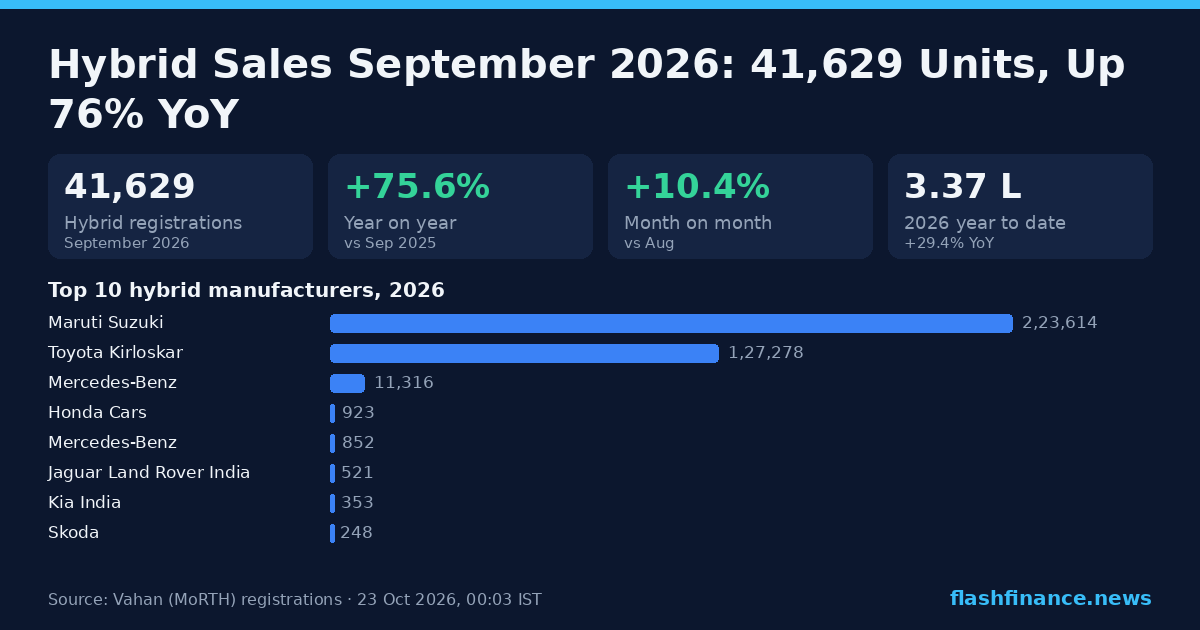
Hybrid Sales September 2026: 41,629 Units, Up 76% YoY
Full Vahan registration report for September 2026 — total volume, month-on-month and year-on-year change, every major hybrid maker ranked by share, which segments those hybrids are in, and the state-wise picture.
How September went
India's hybrid vehicle market registered 41,629 vehicles in September 2026. Volumes rocketed 75.6% against September 2025, and grew 10.4% on August. It was the strongest September in that record.
That is 11 consecutive months of year-on-year growth for the segment. Year to date, 3,36,737 units have been registered across 9 months, +29.4% on the same stretch of 2025 (2,60,294). The segment accounted for 1.6% of every vehicle registered in India that month.
September is the quiet month before the festive peak — buyers routinely defer registrations into the auspicious October window.
Monthly hybrid registrations, 2023–2026
One line per calendar year — the shape of the year, not just its total. The dashed end of the current year is the month so far.
Manufacturer scoreboard
Hybrid registrations per manufacturer over 2026 year to date, and how each company's share of the hybrid market has moved against full-year 2025.
On share rather than volume — the number that decides who is actually winning — Maruti Suzuki has added 1.85pp of the segment in 2026 so far, while Toyota Kirloskar has given up 1.34pp.
Top 10 hybrid manufacturers, 2026
Hybrid registrations year to date
Exact segment volume per manufacturer over 2026 year to date, and the change in share against full-year 2025.
| # | Manufacturer | 2026 units | Share | vs full-year 2025 |
|---|---|---|---|---|
| 1 | Maruti Suzuki | 2,23,614 | 61.17% | +1.85pp |
| 2 | Toyota Kirloskar | 1,27,278 | 34.82% | −1.34pp |
| 3 | Mercedes-Benz | 11,316 | 3.10% | −0.61pp |
| 4 | Honda Cars | 923 | 0.25% | −0.02pp |
| 5 | Mercedes-Benz | 852 | 0.23% | +0.04pp |
| 6 | Jaguar Land Rover India | 521 | 0.14% | +0.01pp |
| 7 | Kia India | 353 | 0.10% | +0.10pp |
| 8 | Skoda | 248 | 0.07% | −0.03pp |
| 9 | BMW India | 207 | 0.06% | 0.00pp |
| 10 | Audi Ag | 88 | 0.02% | −0.02pp |
| 11 | Automobili Lamborghini S.P.A | 46 | 0.01% | 0.00pp |
| 12 | Maserati S.P.A | 29 | 0.01% | 0.00pp |
| 13 | Porsche Ag Germany | 26 | 0.01% | 0.00pp |
| 14 | Bentley Motors Ltd (Savwipl) | 15 | 0.00% | 0.00pp |
| 15 | Ferrari Spa (Importer:Select Cars P Ltd) | 9 | 0.00% | 0.00pp |
Where the hybrids are
Cars & UVs account for 97.1% of every hybrid registered in 2026 so far — 3,55,079 units, a share move of +0.47pp against full-year 2025.
Hybrid volume by segment, 2026
Share of segment registrations year to date
The 2026 year to date mix.
| Segment | 2026 units | Share | vs full-year 2025 |
|---|---|---|---|
| Cars & UVs | 3,55,079 | 97.14% | +0.47pp |
| Taxis & Cabs | 9,280 | 2.54% | −0.37pp |
| Other | 630 | 0.17% | −0.05pp |
| Buses | 553 | 0.15% | −0.05pp |
Share is of this report's own scope over 2026 year to date, compared with the whole of 2025.
Where the demand is
Tamil Nadu was the largest market in 2026 year to date with 35,157 registrations, 9.6% of the segment's national total. Maharashtra (34,431) and Karnataka (33,718) followed. Tamil Nadu has gained the most ground, adding 1.60pp of the national total.
Segment registrations over 2026 year to date, by state.
| # | State | Units | Share | vs full-year 2025 |
|---|---|---|---|---|
| 1 | Tamil Nadu | 35,157 | 9.6% | +1.60pp |
| 2 | Maharashtra | 34,431 | 9.4% | −1.03pp |
| 3 | Karnataka | 33,718 | 9.2% | +0.40pp |
| 4 | Kerala | 29,450 | 8.1% | +0.05pp |
| 5 | Uttar Pradesh | 27,529 | 7.5% | −2.28pp |
| 6 | Haryana | 22,656 | 6.2% | −0.89pp |
| 7 | Gujarat | 20,766 | 5.7% | −0.40pp |
| 8 | Delhi | 19,238 | 5.3% | −0.52pp |
| 9 | Punjab | 18,572 | 5.1% | +0.60pp |
| 10 | Chhattisgarh | 11,382 | 3.1% | −0.25pp |
| 11 | Rajasthan | 10,924 | 3.0% | −0.43pp |
| 12 | Madhya Pradesh | 10,274 | 2.8% | −0.12pp |
Frequently asked questions
How many hybrids were sold in India in September 2026?
Which company sells the most hybrids in India?
What is the hybrid market share in India in 2026?
Which state registers the most hybrids in India?
Are these wholesale dispatches or retail sales?
Hybrid sales, earlier months
More from the reports desk
Source. Every figure is a vehicle registration, taken daily from the Ministry of Road Transport & Highways' Vahan 4 dashboard (vahan.parivahan.gov.in) — the same source FADA and the industry use for retail data. Registrations are not the wholesale dispatch numbers manufacturers announce each month. "EV" means battery electric (Vahan fuels PURE EV and ELECTRIC(BOV)); hybrids are counted separately. Information only, not investment advice.
Using these numbers? Cite "Flash Finance (Vahan data)" with a link to this page. This report's chart card is free to republish with the same credit.