
EV Registrations Surge 74.7% in October as Total Passenger Vehicle Market Contracts 14.6%
India's electric passenger vehicle market posted a robust surge in retail adoption in October 2026, demonstrating strong counter-cyclical growth even as conventional automotive retail demand softened noticeably across the country.
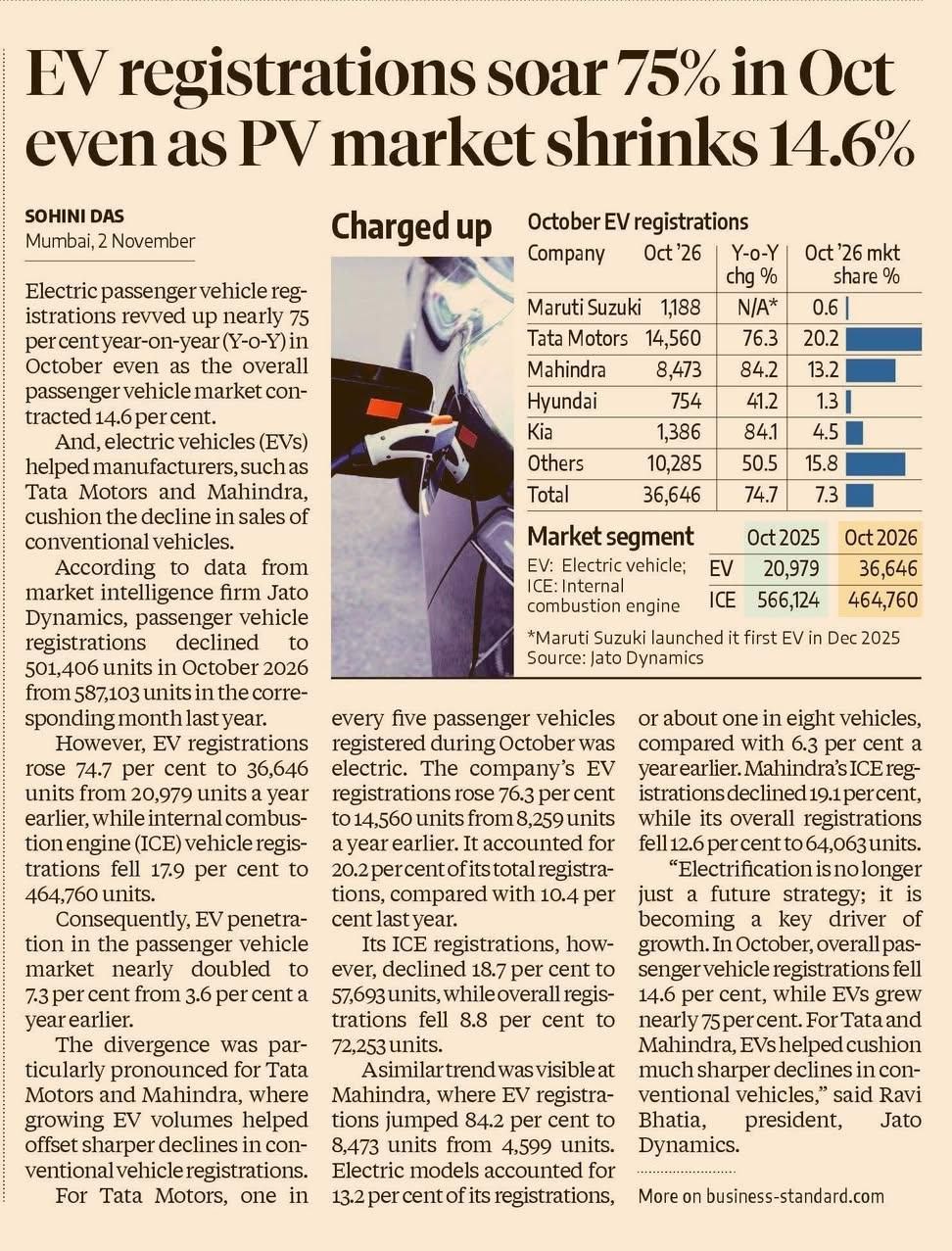
According to data compiled by market intelligence firm JATO Dynamics, total passenger vehicle (PV) registrations across India declined 14.6 percent year-on-year to 501,406 units in October 2026, compared to 587,103 units registered in the corresponding month last year. However, registrations of electric passenger vehicles jumped 74.7 percent year-on-year to 36,646 units from 20,979 units a year ago. Conversely, internal combustion engine (ICE) vehicle registrations declined 17.9 percent year-on-year to 464,760 units from 566,124 units.
As a result, EV penetration in the domestic passenger vehicle space nearly doubled, climbing to 7.3 percent in October 2026 from 3.6 percent in October 2025.
EV Portfolios Cushion ICE Contraction
The sharp divergence between conventional powertrains and electrification was most apparent among India’s leading domestic automakers, notably Tata Motors and Mahindra & Mahindra (M&M). For both original equipment manufacturers (OEMs), strong demand for battery electric models provided a crucial buffer against falling ICE volumes.
For Tata Motors, one in every five passenger vehicles registered during October was electric. The automaker’s EV registrations climbed 76.3 percent year-on-year to 14,560 units, up from 8,259 units in October 2025. EVs accounted for 20.2 percent of the company’s total monthly registrations, compared to 10.4 percent in the previous year. While Tata Motors' ICE registrations fell 18.7 percent to 57,693 units, the rapid expansion of its EV business limited its overall retail contraction to 8.8 percent (72,253 total units).
A comparable trajectory unfolded at Mahindra & Mahindra. Mahindra’s EV registrations advanced 84.2 percent year-on-year to 8,473 units, compared to 4,599 units in October 2025. Electric models represented 13.2 percent of M&M's registrations—roughly one in every eight vehicles sold—up from 6.3 percent a year earlier. In contrast, Mahindra's ICE registrations dropped 19.1 percent, bringing its overall retail volume down 12.6 percent to 64,063 units.
OEM Registrations Breakdown
Data from JATO Dynamics highlights manufacturer-level registration figures for October 2026:
- Tata Motors: 14,560 units (up 76.3% Y-o-Y; 20.2% share within company registrations)
- Mahindra & Mahindra: 8,473 units (up 84.2% Y-o-Y; 13.2% share within company registrations)
- Kia India: 1,386 units (up 84.1% Y-o-Y; 4.5% share within company registrations)
- Maruti Suzuki: 1,188 units (0.6% share within company registrations; company introduced its first EV in December 2025)
- Hyundai Motor India: 754 units (up 41.2% Y-o-Y; 1.3% share within company registrations)
- Other Manufacturers: 10,285 units (up 50.5% Y-o-Y; 15.8% share within registrations)
- Total Industry EV Registrations: 36,646 units (up 74.7% Y-o-Y; 7.3% total PV market penetration)
Structural Shift Towards Clean Mobility
Industry observers point out that the retail slowdown in ICE vehicles contrasts with OEM wholesale despatches, which grew 12.4 percent year-on-year to 528,384 units in October, driven by dispatches ahead of the festive season. However, end-user registrations clearly favor a structural migration toward electric alternatives.
"Electrification is no longer just a future strategy; it is becoming a key driver of growth," noted Ravi Bhatia, President of JATO Dynamics. "In October, overall passenger vehicle registrations fell 14.6 per cent, while EVs grew nearly 75 per cent. For Tata and Mahindra, EVs helped cushion much sharper declines in conventional vehicles. As customers increasingly consider electric alternatives, the advantage will go to manufacturers that deliver on price, range, and ownership experience."
Bhatia also warned that manufacturers slow to broaden their electrified portfolios face the imminent risk of ceding domestic market share even before the broader automotive industry resumes its overall growth trajectory.
