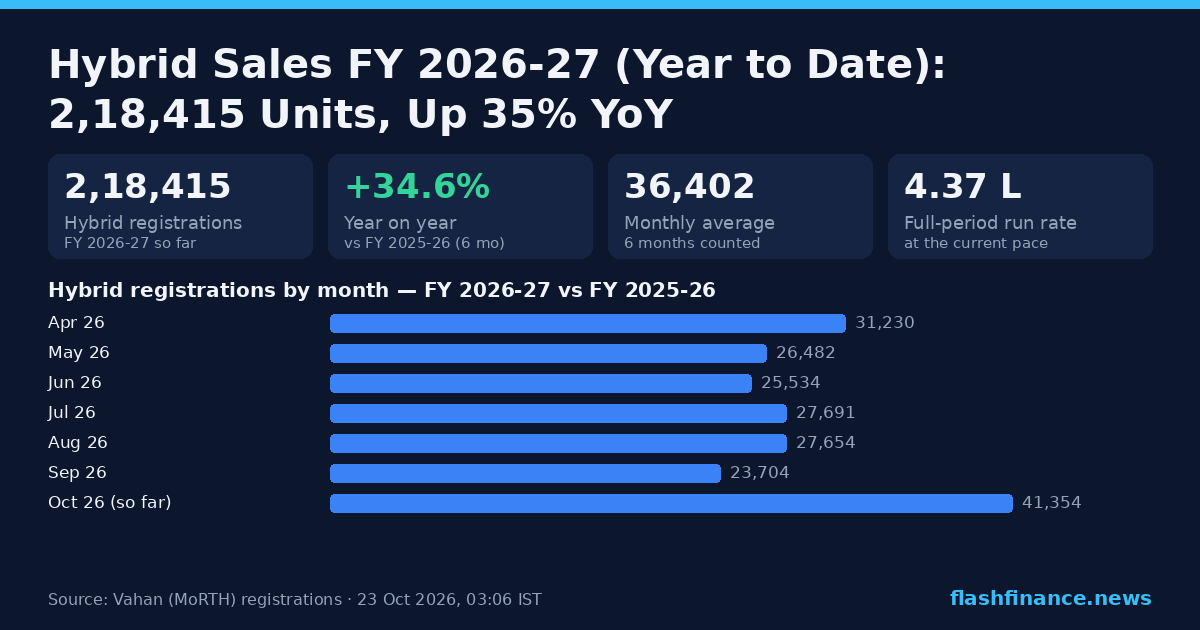
Hybrid Sales FY 2026-27 (Year to Date): 2,18,415 Units, Up 35% YoY
Every hybrid registered in India over FY 2026-27 so far — April 2026 to September 2026. India's financial year runs April to March, the window every listed automaker reports on. Month-by-month volumes, the manufacturer leaderboard, which segments those hybrids are in, and the same window in every earlier year on record.
Live. FY 2026-27 is still in progress — this page updates every day as new registrations are published.
Hybrid sales month by month, FY 2026-27
India's hybrid vehicle market registered 2,18,415 hybrids in FY 2026-27 so far. Volumes jumped 34.6% against the 1,62,295 logged over the same 6 months of FY 2025-26.
September was the strongest month of the period at 41,629 hybrids and May the quietest at 33,619, an average of 36,402 a month. Every one of those 6 months grew on the same month a year earlier.
FY 2026-27 still has 6 months to run. Held at the pace of the 6 months already counted, it would finish near 4.37 L hybrids — a run rate rather than a forecast, and the festive quarter moves it more than anything else on this page.
Hybrids accounted for 1.4% of everything registered in India over the period, up from 1.3% in FY 2025-26. The whole market ran to 1,55,81,206 vehicles over the same window, up 21.0% year on year.
Hybrid registrations by month — FY 2026-27 vs FY 2025-26
Vahan retail registrations, each month set against the same month a year earlier. The lighter bar is October so far, not yet in the FY 2026-27 total.
Every completed month of FY 2026-27, with the matching month of FY 2025-26 beside it.
| Month | FY 2026-27 units | FY 2025-26 units | YoY | Share of period |
|---|---|---|---|---|
| April 2026 | 35,655 | 31,230 | +14.2% | 16.3% |
| May 2026 | 33,619 | 26,482 | +27.0% | 15.4% |
| June 2026 | 35,217 | 25,534 | +37.9% | 16.1% |
| July 2026 | 34,603 | 27,691 | +25.0% | 15.8% |
| August 2026 | 37,692 | 27,654 | +36.3% | 17.3% |
| September 2026 | 41,629 | 23,704 | +75.6% | 19.1% |
Each month links through to its own full report.
Who is selling the hybrids
Our Vahan data holds manufacturer volumes split by fuel only across a whole calendar year, so the hybrid leaderboard below covers 2026 year to date rather than FY 2026-27 alone. It is exact for that window.
Maruti Suzuki holds 61.2% of hybrid registrations over 2026 year to date, ahead of Toyota Kirloskar.
Top hybrid manufacturers — 2026 year to date
Hybrid registrations only; pure battery EVs are counted separately.
| # | Manufacturer | Hybrid units | Share | vs full-year 2025 |
|---|---|---|---|---|
| 1 | Maruti Suzuki | 2,23,614 | 61.17% | +1.85pp |
| 2 | Toyota Kirloskar | 1,27,278 | 34.82% | −1.34pp |
| 3 | Mercedes-Benz | 11,316 | 3.10% | −0.61pp |
| 4 | Honda Cars | 923 | 0.25% | −0.02pp |
| 5 | Mercedes-Benz | 852 | 0.23% | +0.04pp |
| 6 | Jaguar Land Rover India | 521 | 0.14% | +0.01pp |
| 7 | Kia India | 353 | 0.10% | +0.10pp |
| 8 | Skoda | 248 | 0.07% | −0.03pp |
| 9 | BMW India | 207 | 0.06% | 0.00pp |
| 10 | Audi Ag | 88 | 0.02% | −0.02pp |
| 11 | Automobili Lamborghini S.P.A | 46 | 0.01% | 0.00pp |
| 12 | Maserati S.P.A | 29 | 0.01% | 0.00pp |
| 13 | Porsche Ag Germany | 26 | 0.01% | 0.00pp |
| 14 | Bentley Motors Ltd (Savwipl) | 15 | 0.00% | 0.00pp |
| 15 | Ferrari Spa (Importer:Select Cars P Ltd) | 9 | 0.00% | 0.00pp |
Which segments the hybrids are in
The chart is period-exact: it is the hybrid share of every vehicle registered in each month of FY 2026-27. The split by segment underneath comes from a calendar-year table — Vahan publishes class against fuel only across a whole year — so it covers 2026 year to date.
Hybrid share of the Indian market, month by month
Hybrids as a percentage of every vehicle registered that month.
Strong, mild and plug-in hybrids together; pure battery EVs are counted separately.
| Segment | 2026 hybrid units | Share | vs full-year 2025 |
|---|---|---|---|
| Cars & UVs | 3,55,079 | 97.14% | +0.47pp |
| Taxis & Cabs | 9,280 | 2.54% | −0.37pp |
| Other | 630 | 0.17% | −0.05pp |
| Buses | 553 | 0.15% | −0.05pp |
Fuel mix, FY 2026-27
Battery-electric vehicles were 11.6% of every registration in FY 2026-27, against 8.8% in FY 2025-26. That is 18,12,546 electric vehicles across all segments.
Fuel labels come straight from Vahan and the split below covers the whole market over April 2026 to September 2026 — petrol includes the E20 ethanol blend, which is now the single largest label in the database.
Registrations by fuel — FY 2026-27
Every vehicle registered in the period, by fuel.
Exact fuel volumes over April 2026 to September 2026.
| Fuel | FY 2026-27 units | Share | vs FY 2025-26 | Share move |
|---|---|---|---|---|
| Petrol | 1,10,31,718 | 70.80% | +16.0% | −3.01pp |
| Electric | 18,12,546 | 11.63% | +59.8% | +2.83pp |
| Diesel | 16,19,107 | 10.39% | +19.9% | −0.09pp |
| CNG / LPG | 8,62,989 | 5.54% | +24.6% | +0.16pp |
| Hybrid | 2,18,415 | 1.40% | +34.6% | +0.14pp |
| Other | 36,431 | 0.23% | +6.6% | −0.03pp |
Hybrid sales by financial year
Across the 2 completed windows in our Vahan record, hybrid registrations went from 3,63,814 in FY 2024-25 to 3,89,325 in FY 2025-26, up 7.0% over the stretch.
FY 2026-27 is still running — 6 of its 12 months are counted — so it is a part window and is never set against a full one. Its year-on-year figure compares only the months it actually holds.
Hybrid registrations by financial year
* window still in progress.
| Period | Months | Units | YoY |
|---|---|---|---|
| FY 2026-27 (to date) | 6 | 2,18,415 | +34.6% |
| FY 2025-26 | 12 | 3,89,325 | +7.0% |
| FY 2024-25 | 12 | 3,63,814 | +12.2% |
Each row compares only the months that window holds, so a part period is never set against a full one.
Frequently asked questions
How many hybrids were sold in India in FY 2026-27?
What period does FY 2026-27 cover?
Which was the strongest month for hybrid sales in FY 2026-27?
What will full-year FY 2026-27 hybrid sales be?
Which financial year had the highest hybrid sales?
Are these retail sales or factory dispatches?
Hybrid sales, other periods
More from the reports desk
Source. Every figure is a vehicle registration, taken daily from the Ministry of Road Transport & Highways' Vahan 4 dashboard (vahan.parivahan.gov.in) — the same source FADA and the industry use for retail data. Registrations are not the wholesale dispatch numbers manufacturers announce each month. "EV" means battery electric (Vahan fuels PURE EV and ELECTRIC(BOV)); hybrids are counted separately. Information only, not investment advice.
Using these numbers? Cite "Flash Finance (Vahan data)" with a link to this page. This report's chart card is free to republish with the same credit.