Hybrid Sales Q3 FY 2024-25: 97,699 Units, Up 28% YoY
Every hybrid registered in India over Q3 FY 2024-25 — October 2024 to December 2024. Q3 of the financial year, October to December. Month-by-month volumes, the manufacturer leaderboard, which segments those hybrids are in, and the same window in every earlier year on record.
Hybrid sales month by month, Q3 FY 2024-25
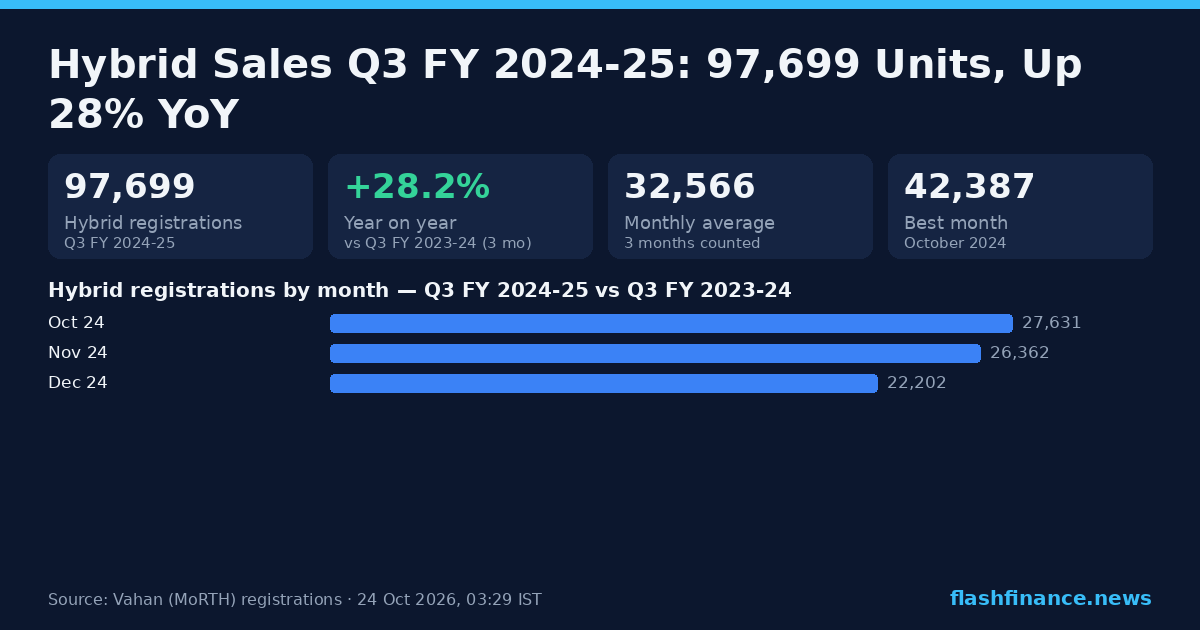
India's hybrid vehicle market registered 97,699 hybrids in Q3 FY 2024-25. Volumes climbed sharply 28.2% against the 76,195 logged over the same 3 months of Q3 FY 2023-24.
October was the strongest month of the period at 42,387 hybrids and December the quietest at 27,147, an average of 32,566 a month. Every one of those 3 months grew on the same month a year earlier.
October is the festive peak. Navratri and Diwali make it the single biggest registration month of most years, so year-on-year comparisons swing on where the festivals fall.
Q3 FY 2024-25 ran from October 2024 to December 2024 and is closed. Every month in the table below is final, and every comparison on this page is against the matching month of Q3 FY 2023-24.
Hybrids accounted for 1.2% of everything registered in India over the period, up from 1.0% in Q3 FY 2023-24. The whole market ran to 81,63,589 vehicles over the same window, up 11.6% year on year.
Hybrid registrations by month — Q3 FY 2024-25 vs Q3 FY 2023-24
Vahan retail registrations, each month set against the same month a year earlier.
Every completed month of Q3 FY 2024-25, with the matching month of Q3 FY 2023-24 beside it.
| Month | Q3 FY 2024-25 units | Q3 FY 2023-24 units | YoY | Share of period |
|---|---|---|---|---|
| October 2024 | 42,387 | 27,631 | +53.4% | 43.4% |
| November 2024 | 28,165 | 26,362 | +6.8% | 28.8% |
| December 2024 | 27,147 | 22,202 | +22.3% | 27.8% |
Each month links through to its own full report.
Who is selling the hybrids
Our Vahan data holds manufacturer volumes split by fuel only across a whole calendar year, so the hybrid leaderboard below covers full-year 2024 rather than Q3 FY 2024-25 alone. It is exact for that window.
Maruti Suzuki holds 65.8% of hybrid registrations over full-year 2024, ahead of Toyota Kirloskar.
Top hybrid manufacturers — full-year 2024
Hybrid registrations only; pure battery EVs are counted separately.
| # | Manufacturer | Hybrid units | Share | vs full-year 2023 |
|---|---|---|---|---|
| 1 | Maruti Suzuki | 2,35,177 | 65.79% | −9.65pp |
| 2 | Toyota Kirloskar | 1,07,912 | 30.19% | +8.41pp |
| 3 | Mercedes-Benz | 10,944 | 3.06% | +1.49pp |
| 4 | Honda Cars | 1,375 | 0.38% | −0.03pp |
| 5 | Jaguar Land Rover India | 618 | 0.17% | −0.14pp |
| 6 | Skoda | 465 | 0.13% | −0.08pp |
| 7 | BMW India | 374 | 0.10% | +0.01pp |
| 8 | Mercedes-Benz | 337 | 0.09% | 0.00pp |
| 9 | Audi Ag | 213 | 0.06% | −0.01pp |
| 10 | Others | 17 | 0.00% | −0.01pp |
| 11 | Maserati S.P.A | 11 | 0.00% | 0.00pp |
| 12 | Ferrari Spa | 7 | 0.00% | 0.00pp |
| 13 | Mclaren Automotive (Importer: Infinity Cars) | 6 | 0.00% | 0.00pp |
| 14 | Ferrari Spa (Importer:Navnit Motors Pvt Ltd) | 6 | 0.00% | 0.00pp |
| 15 | Ferrari Spa (Importer:Select Cars P Ltd) | 4 | 0.00% | 0.00pp |
Which segments the hybrids are in
The chart is period-exact: it is the hybrid share of every vehicle registered in each month of Q3 FY 2024-25. The split by segment underneath comes from a calendar-year table — Vahan publishes class against fuel only across a whole year — so it covers full-year 2024.
Hybrid share of the Indian market, month by month
Hybrids as a percentage of every vehicle registered that month.
Strong, mild and plug-in hybrids together; pure battery EVs are counted separately.
| Segment | 2024 hybrid units | Share | vs full-year 2023 |
|---|---|---|---|
| Cars & UVs | 3,42,966 | 95.94% | −1.49pp |
| Taxis & Cabs | 13,119 | 3.67% | +1.53pp |
| Buses | 759 | 0.21% | −0.01pp |
| Other | 631 | 0.18% | −0.03pp |
| Two-Wheelers | 1 | 0.00% | 0.00pp |
Fuel mix, Q3 FY 2024-25
Battery-electric vehicles were 7.0% of every registration in Q3 FY 2024-25, against 6.2% in Q3 FY 2023-24. That is 5,74,836 electric vehicles across all segments.
Fuel labels come straight from Vahan and the split below covers the whole market over October 2024 to December 2024 — petrol includes the E20 ethanol blend, which is now the single largest label in the database.
Registrations by fuel — Q3 FY 2024-25
Every vehicle registered in the period, by fuel.
Exact fuel volumes over October 2024 to December 2024.
| Fuel | Q3 FY 2024-25 units | Share | vs Q3 FY 2023-24 | Share move |
|---|---|---|---|---|
| Petrol | 63,49,608 | 77.78% | +9.5% | −1.52pp |
| Diesel | 7,33,337 | 8.98% | +10.5% | −0.08pp |
| Electric | 5,74,836 | 7.04% | +27.6% | +0.88pp |
| CNG / LPG | 3,86,174 | 4.73% | +26.9% | +0.57pp |
| Hybrid | 97,699 | 1.20% | +28.2% | +0.16pp |
| Other | 21,935 | 0.27% | +10.0% | 0.00pp |
Every Q3 on record
Across the 2 completed windows in our Vahan record, hybrid registrations went from 97,699 in Q3 FY 2024-25 to 1,08,708 in Q3 FY 2025-26, up 11.3% over the stretch.
Hybrid registrations by quarter
* window still in progress.
| Period | Months | Units | YoY |
|---|---|---|---|
| Q3 FY 2025-26 | 3 | 1,08,708 | +11.3% |
| Q3 FY 2024-25 | 3 | 97,699 | +28.2% |
Each row compares only the months that window holds, so a part period is never set against a full one.
Frequently asked questions
How many hybrids were sold in India in Q3 FY 2024-25?
What period does Q3 FY 2024-25 cover?
Which was the strongest month for hybrid sales in Q3 FY 2024-25?
Which quarter had the highest hybrid sales?
Are these retail sales or factory dispatches?
Hybrid sales, other periods
More from the reports desk
Source. Every figure is a vehicle registration, taken daily from the Ministry of Road Transport & Highways' Vahan 4 dashboard (vahan.parivahan.gov.in) — the same source FADA and the industry use for retail data. Registrations are not the wholesale dispatch numbers manufacturers announce each month. "EV" means battery electric (Vahan fuels PURE EV and ELECTRIC(BOV)); hybrids are counted separately. Information only, not investment advice.
Using these numbers? Cite "Flash Finance (Vahan data)" with a link to this page. This report's chart card is free to republish with the same credit.